Back in 1986, I was a man in transition. I had just finished my Ph.D. at Ferkauf Graduate School in New York City, and a good deal of my training was psychodynamic. That was where the field was at the time. The program also required us to undergo psychotherapy. Ferkauf had an arrangement with the William Alanson White Psychoanalytic Institute, and that’s where we went for our own treatment, at a greatly reduced fee. My seven fellow doctoral candidates were all offered once‑a‑week therapy; I was offered full psychoanalysis. To this day I don’t know whether someone thought I was a particularly interesting patient or in particular need of intensive treatment. In any case, I went three times a week for two years and lay on the couch, just like in the movies.
In 1985 my wife and I moved to Cincinnati so I could complete a postdoctoral retraining internship in clinical psychology. My doctorate was in school psychology, but I had decided to transition to clinical work and took a job at the local state hospital. While I was learning how to be a clinician, I also started thinking about writing projects. Maybe I could do something popular in the same general vein as Irving Yalom or Oliver Sacks: case studies that were interesting, entertaining, and instructive. I’d always had a taste for unusual psychiatric syndromes.
Eventually I stumbled onto a group of just the kinds of cases I was looking for: what were then called “culture-bound syndromes.” Clinicians used that label for patterns of distress or behavior that only seemed to occur in particular cultural settings. These were conditions that local communities treated as real illnesses, but that didn’t line up neatly with standard textbook diagnoses because they grew out of that culture’s own beliefs, fears, and explanations for suffering.
A few examples still show up in DSM and ICD under various headings: koro (the acute panic that the penis is retracting into the body and will cause death), piblokto or “Arctic hysteria” (episodes among Inuit women involving screaming, stripping, mimicry, followed by amnesia), dhat syndrome (a South Asian folk diagnosis centered on semen-loss anxiety), and latah (startle-induced automatic obedience, echolalia, and echopraxia in parts of Southeast Asia). That’s just a sampling. At the time, I thought a book describing and explaining these syndromes would be just the ticket. I even had a title in mind: The Culture‑Bound Syndromes: A Psychotravelogue. So I got to work.
I never finished the book, but I did draft a few chapters. As I bought new computers over the years, I kept backing up my files, and the chapters quietly tagged along. Eventually I forgot they existed. Decades went by. I became busy with clinical and forensic work and, somewhere along the way, started this blog. Then sometime last year, while clearing out disk space, I found those old chapters again. It occurred to me that with a little updating, they might make good posts. I started with the one on Windigo psychosis. It opened with this missionary vignette:
“During the work of this mission at Wamoutashing, one of the savages usually kept himself behind all the others. It appeared to me that there was something extraordinary to uncover in this idiosyncrasy; nevertheless, I left it alone for a few days, then I approached my man and wanted to know the reason for this particular behavior. “Black-robe,” he said to me in a timid and plaintive tone, “I do not pray, I am not a Christian; on the contrary, I always escaped from you because I did not want to give up liquor; but last winter I was seized with horror at a harrowing spectacle which I witnessed. There was among us a woman who said several times: ‘I must have human flesh, I want to eat some human flesh’. We did not understand why she spoke in this manner; then, one evening, taking her knife, she thrust it into the breast of her child, and in a state of a fury which cannot be described, she roasted him and ate him by the light of the same fire. Seized with horror, we fled from this cursed place. At the same time, my heart changed; it seemed to me that I ought to embrace the religion which bans this crime. That is why I come to ask you to teach me and to receive me in your religion.’”
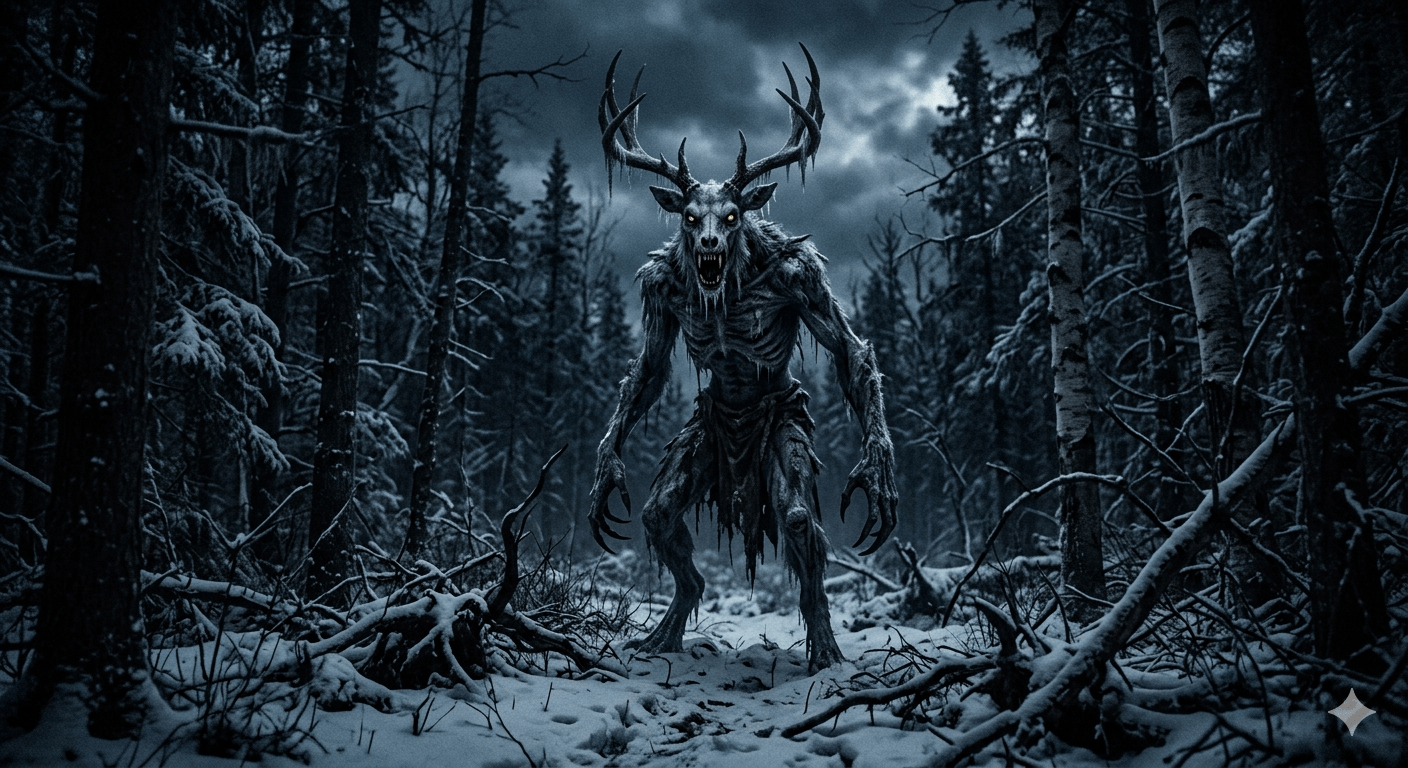
I then went on, in best 1980s fashion, to set the scene: “Among the Ojibwa Indians of eastern Canada an unusual and macabre form of mental illness was once seen whose name evoked terror in all who knew of it. Found nowhere else in the world, this condition was known as Windigo.” From there I moved straight into a confident description of Windigo psychosis: possession by an evil spirit, overwhelming compulsions to devour human flesh, hallucinations of people as game animals, followed by nausea, depression, and catatonia. It was a good story.
When I found the chapter last year and started editing, I thought it still sounded pretty good, but right away something about that opening vignette bothered me. Rereading it decades later, it felt less like an observed crisis and more like a crafted missionary morality tale. The woman’s repeated declarations about wanting “human flesh,” the unresisted killing and eating of her child, the absence of any concrete kin or communal response, and the narrator’s thin “we fled from this cursed place” all feel oddly generic for an event of that magnitude.
What really jumped out was the convert’s line about wanting “the religion that bans this crime,” as if his own people were fine with a mother killing and roasting her child until the missionaries arrived. That’s not ethnography; it’s theology. It quietly erases the community’s own moral universe and makes Christianity the sole source of basic prohibitions that any human group would already share. Add in the man’s instant conversion from liquor‑loving “pagan” to eager Christian, and the whole thing lines up a little too neatly with nineteenth‑century missionary temperance and conversion agendas. At this point my hunch is that I’m looking at a missionary set piece—a polished morality tale for donors—rather than something I’d want to treat as solid clinical or ethnographic evidence.
Stories like this didn’t appear in a vacuum. From the seventeenth century on, European and North American readers devoured “captivity narratives” in which a Christian captive or witness recounts the horrors of life among dangerous others—Indigenous people in the New World, or “Barbary pirates” and North African Muslims around the Mediterranean. A shocking atrocity, a spell in an alien culture, and a rescue or conversion at the end: it’s the same basic script, and it was routinely used to raise money and support for missions. Once you’ve read enough of those, it’s hard not to see my original Windigo vignette as another variation on the theme.
But I didn’t know any of that at the time. Most of the anthropologists and psychiatrists I was reading back then—people like Ruth Landes, C. A. Parker, Morton Teicher, and others—described Windigo psychosis as if it were a relatively coherent psychoanalytic syndrome among Northern Algonkian hunters. The story went like this: the Ojibwa lived on the margins of the Arctic, with long winters, sparse game, and highly dispersed family hunting territories where a single household might spend months in near‑total isolation. In that harsh setting, child‑rearing and socialization were said to mold an “Ojibwa personality” especially vulnerable to Windigo.
These theorists speculated that Ojibwa boys were socialized early into solitary hunting roles, praised for killing small animals, discouraged from open displays of affection, and urged—often by their mothers—to undertake periods of ceremonial fasting to secure powerful guardian spirits. The same mother who first supplied milk and comfort was also the primary agent of frustration, insisting on fasting and toughness and thereby becoming, in the child’s unconscious, both a nurturing and a withholding, even malevolent, figure. Under repeated deprivation, anger at this lost or withheld nurturance was said to turn inward as depression, especially after failed hunts that threatened both physical survival and masculine self‑esteem. Cannibalistic ideation, when it surfaced, could then be read as a way to destroy and incorporate the frustrating other in a single act: you symbolically preserved the relationship by eating the person you also wished to annihilate.
In this classic formulation, universal cannibalistic imagery—found in dreams, ritual, idioms of affection, and religious symbolism—provided the raw material, while Ojibwa ecology and child‑rearing gave it a specific, dangerous form. During periods of food insecurity, some vulnerable individuals were said to progress from despondent withdrawal into a state in which they believed themselves possessed by the Windigo spirit, killing and eating those around them until stopped by their community. It’s an elegant story, but it’s built almost entirely on psychodynamic speculation about Ojibwa men, with very little attention to women’s experience or to the larger historical and political setting in which these accounts were produced.
At the time, that elegance was part of the appeal. I’d been marinated in psychoanalytic thinking: people carry painful wishes and conflicts they can’t face, push them into an “unconscious” part of the mind, and those buried problems leak out indirectly as symptoms or puzzling relationship patterns. Put that together with a grotesque tale about cannibalism in the northern woods, and you have an almost irresistible package for a young psychologist who likes strange stories.
That neat psychoanalytic picture didn’t go unchallenged. Anthropologists and cultural psychiatrists who came along later have been much less sure that “Windigo psychosis” ever existed as a distinct disorder. The most influential skeptic is Lou Marano, who spent years working with Northern Algonkian communities and combed through the archival record. His conclusion was blunt: there’s no solid evidence for genuine “Windigo psychotics” at all. Early writers blurred together what people said about Windigos with what outsiders actually saw and treated stories, rumors, and accusations as if they were clinical case reports.
Marano argued that much of the classic Windigo literature rests on a basic muddle: early writers took Ojibwe stories and accusations about people “turning Windigo” — the community’s own way of talking about fear, famine, and violence — and treated them as if they were neutral psychiatric case reports describing a single, well‑defined disorder.
What is true is that if you go back far enough, almost every society has faced situations where people resorted to cannibalism—sometimes as a desperate response to famine or shipwreck, sometimes in tightly regulated rituals, and sometimes in rare, deeply transgressive crimes. Modern Western examples like Jeffrey Dahmer, the “Milwaukee Cannibal,” remind us that cannibalism does not belong to “primitive” cultures; it is a human possibility that usually sits far outside a community’s moral boundaries, surfacing only under extreme pressure or in isolated, pathological cases.
At this point I found myself imagining an alternate history. In this version, it’s not Europeans “discovering” North America; it’s a shipload of Algonkian explorers “discovering” Britain and claiming it for the United Tribes of America. Their anthropologists dutifully write home about a people whose children are lulled to sleep with Hansel and Gretel, a story about a witch who fattens kids up and eats them, and whose central religious ritual involves symbolically consuming the body and blood of their god. From this they construct an elaborate theory about the British psyche: clearly these primitives are obsessed with cannibalism, forever struggling to control a barely repressed urge to kill and eat one another. On that reading, Hansel and Gretel and the Eucharist become the diagnostic keys to a uniquely British culture‑bound syndrome.
When I first wrote about Windigo years ago, I ended the chapter with a summary of a 1966 case report by William Bolman and Alan Katz, “Hamburger Hoarding: A Case of Symbolic Cannibalism Resembling Whitico Psychosis,” in which a 37‑year‑old secretary developed an overwhelming urge to carry and hoard raw meat—eventually buying up to sixty pounds of hamburger a day—as she wrestled with intense fears of abandonment and fantasies of devouring those she loved. At the time, the parallels felt irresistible: hunger, meat, and a self‑description of feeling “like ice inside”—all neatly echoing the Windigo’s heart of ice and the slide from fantasy to threat.
Rereading that ending now, I can still appreciate the narrative symmetry, but I’m much less willing to mistake a clever parallel for evidence that these things all belong under the same diagnostic heading.
It was only later, when I began working in the legal arena as a forensic psychologist, that I really started to think about these questions more critically, because the setting forced me to. It’s one thing to sit in a case conference and theorize; it’s quite another to have a highly trained lawyer keep asking, “How do you know?” and “What evidence is there for that?” After a few years of answering those questions under oath, it gets much harder to take any of it on trust—new diagnoses, elegant theories, or even sweeping health claims—without asking what, exactly, we can show actually happened.
Discover more from Samurai Shrink (formally Wandering Shrink)
Subscribe to get the latest posts sent to your email.

