
I never set out to be “the MSBP guy.” For a few years, though, if there was a high-profile Munchausen by proxy case in the news, there was a decent chance I’d end up on a plane, in a courtroom, or in front of a camera talking about it.
Back in 1998, I had a mixed practice as a clinical psychologist. I saw patients every day, and because I had found a mentor, Wilfrid Derby, Ph.D., ABPP (Clinical and Forensic), I was starting to take court‑related cases. I’d met Dr. Derby at a conference and we hit it off immediately. He was 68 when we first crossed paths, and now I’m 70; sometimes I think, “This is where I came in.” Before he was Dr. Derby, he had been Captain Derby of the U.S. Coast Guard. I’d never been in the military, so what did I know? I thought a captain in the Coast Guard was the same as a captain in the army. Wrong; they’re at the level of an army colonel. His father, Wilfrid Derby Sr., had been an admiral in the Coast Guard and commandant of the Coast Guard Academy.
I recall that Derby told me in that booming, military voice of his, “Eric, you should consider expanding into forensic psychology.” I think I replied, “Absolutely…what is forensic psychology?” The rest is history. Forensic psychologists at that time were in short supply—still are, come to that. In a matter of six months, forensic cases had taken over my practice.
Stumbling into MSBP
Around this time, I went to my first American Psychological Association conference, mostly because it was in Boston. If you’re not in a big professional organization, you might not know how these conventions work. You show up, get your badge and bag of swag, and they give you a huge book listing paper presentations, symposia, and workshops.
I looked over the schedule and found an offering on Munchausen syndrome by proxy, or MSBP. I’d never heard of it, but I’d always had an interest in unusual psychiatric syndromes, and it was happening soon, so I thought I’d give it a try. I don’t remember much about the symposium—that was a very long time ago. I caught the bus and headed back to New Hampshire. I thought that was that.
About a week later, the stars aligned, and I got a call from an attorney I’d worked with several times. “Hey Eric, you know anything about MSBP?”
“Well, I did attend a 90‑minute symposium a few weeks ago.”
There was a chuckle on the other end of the line. “Well, that makes you the premier authority on the subject in Northern New England, as far as I can tell.” So I was engaged to consult on the case.
I don’t want to make this a dissertation on MSBP. If you’re really interested, you can buy a copy of my book, Munchausen Syndrome by Proxy Reconsidered, on Amazon at competitive prices. But briefly, the idea is this:
- A caregiver presents a child as sick when they are not—by exaggerating, fabricating, or inducing symptoms.
- They do it to occupy the sick role by proxy rather than for obvious external gain.
- The behavior isn’t better explained by another disorder, such as delusional beliefs about illness.
It’s a complicated diagnosis, with a long history and a tangle of changing names. That’s not where I’m going here. What matters for this story is what happened next.
Diagnosis du Jour
In the recent history of psychology, there’s a familiar pattern: a diagnosis gets hot and suddenly it’s everywhere. Multiple Personality Disorder (now Dissociative Identity Disorder) surged in the 1980s–1990s after it appeared in DSM-III, with critics arguing that many cases were essentially created in the therapy room. Pediatric bipolar disorder followed, with childhood diagnoses skyrocketing and a growing sense that ordinary irritability and moodiness were being relabeled as a severe mood disorder.
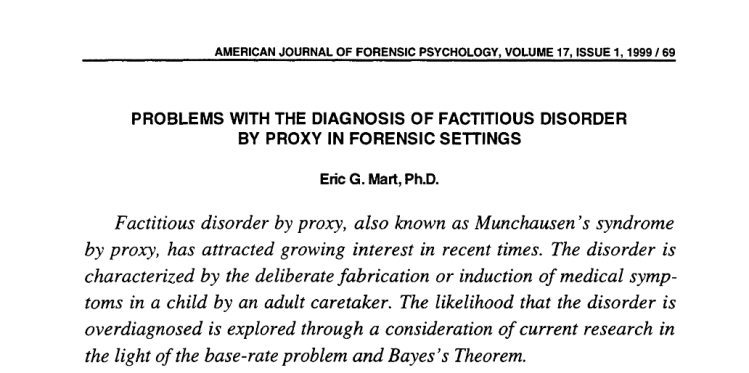
MSBP arrived right on schedule in that parade. When I dove into the literature after that first referral, what I found was not a solid body of evidence but a pile of case reports and small, biased samples. Sir Roy Meadow, the British pediatrician who coined the term, had certainly seen some horrifying cases—parents poisoning their children with salt, tampering with urine samples, and staging illnesses for attention. Those cases were real.
The research that followed, though, often took a handful of such families and treated their common features as “red flags”: personality disorders, health anxiety, marital conflict, and family dysfunction. If you’ve spent any time in mental health or family court, you know those “red flags” are everywhere. Personality traits, somatic complaints, messy relationships, and chaotic family histories are more the rule than the exception in stressed clinical populations.
If you’re a mother under suspicion and someone goes looking for these traits, the odds are very good they’ll find at least one. That seemed obvious to me even then. It just hadn’t yet become obvious to the people building profiles and checklists.
All Dressed Up With Nowhere to Go
I never testified in that first case, even though I dressed up in my suit and tie and sat in the waiting area. In that case, the mother was suspected of fabricating seizures in her baby. But in reviewing the records, I found a doctor’s note. The mother was talking to the pediatrician when the baby’s hands started shaking. The mother told the doctor, “Look, she’s having a seizure now!” Luckily, the doctor saw it and realized it was a benign infantile tremor.
The case was dismissed by the judge on a directed verdict. For those of you who don’t hang around courtrooms, a directed verdict occurs when the prosecution—or the lawyer representing the child protection agency—presents their whole case and the judge decides that even if everything they’ve presented is true, it still wouldn’t meet the standard of evidence necessary to prove the case.
So there I was, all dressed up (literally and figuratively) with nowhere to go. I had read everything I could lay my hands on about this obscure syndrome, noticed that the research was generally crap, and never got to testify. I didn’t know if I would ever have another MSBP case. But I had a feeling I was onto something and that there was an article in there somewhere.
I thought journal articles were written by psychology gods who lived on Mount Olympus. A friend who was an actual academic psychologist disabused me of that. He liked my outline, suggested I turn it into a paper, and told me it would be easier to present it at a regional psychology conference than to wait a year for journal publication. So I did.
That year the Eastern Psychological Association was in Boston, which suited me fine. I wrote the paper, submitted it, and, to my surprise, it was accepted. In my office, when we get particularly good news, I shout out, “It’s time to do the boogie dance!” and go to work. My wife doesn’t join in; she just looks on and enjoys the spectacle. I only do the boogie dance when there are no patients in the office, and the less said about the dance itself, the better.
We turned it into a family trip. My son has always loved swank hotels, so we checked into the Boston Long Wharf.

The next morning I discovered, to my consternation, that I had not packed a dress shirt. I have a fair amount of chest hair. Maybe if I just put on my tie and jacket, the audience would think I was wearing a sweater. No, bad idea.
I ran over to Downtown Crossing and walked up and down the street looking for a store that opened early. At last I found a place that sold remaindered goods and found a shirt that fit. It was a strange color I can’t really describe and had a scorch mark from an overheated iron on the back, but any port in a storm. I ran down to the convention center with my box of papers and gave my presentation. To my surprise, people kept asking for the paper and I managed to hand out about thirty copies.
I reworked it, submitted it to a journal, and it was accepted; more boogie dancing.
The MSBP Guy
Then something strange and unforeseen happened. I started getting referrals from all over the country—Texas, New Jersey, California, Florida, and so on. They started flying me around for every high‑profile case going. I’d like to say it was because of my incredible intellect and brilliant testimony, but that wasn’t it. It was literally the fact that there were no other defense-oriented witnesses.
These things run in fads, and once the idea of MSBP got popular, most of the experts and practitioners piled on the pro-MSBP side of the equation. People developed red flags and behavioral profiles. If you were getting divorced and really wanted to stick it to your soon-to-be ex-wife, you played the MSBP card. Don’t get me wrong; sometimes I came across the real thing, and that is always deeply disturbing. But lots of overprotective mothers also got scooped up. My services were in demand.
Up to this point, I was what I would call a regional expert, working mostly in New Hampshire, Vermont, and Maine. After all, why fly me out to Seattle to do a competence‑to‑stand‑trial evaluation? They have their own experts out there. But now, unlooked for, I was a national expert, at least in MSBP. Looking back, I think I must have testified in at least thirty‑six states.
Nothing had prepared me for it. I recall one high‑profile case in North Carolina: I flew in, prepared with the defense attorneys, and went back to my hotel. The next day, I suited up and went to court. Witnesses were sequestered, which means you don’t sit in court and listen; you park it in a waiting room and wait to be called.
The bailiff came to get me and led me into the courtroom. Imagine my surprise when I saw that not only was the court packed with spectators and the jury, but there was a bank of reporters and cameras waiting. It was a circus. As I walked to the witness box, I recall thinking that I wished I’d bought a spiffier suit.
Media, Magic Tricks, and Tennis Balls
Around this time I started getting calls from the media for interviews. NBC, CBS, the BBC, and God help me, Geraldo. Hell, I even got a call from a news station in Japan. I went to dinner with a well-known writer from The New Yorker, who prominently featured me in an article. All of a sudden I was about as much of a celebrity as a psychologist gets, and I was flying blind.
Some of what happened was pretty funny. For example, 20/20 flew me down to Louisville for a piece. I made a rookie mistake heading down there. For some reason, I checked my bag with my suit rather than carrying it onto the plane, and when we touched down, my bag was missing. The airline people told me they would find it and send it to my hotel.
That night, I called the female correspondent; I just can’t remember her name, but I do recall it was someone I’d seen previously on the news. I told her I had some good news and some bad news. The bad news was that my suit had gone missing. “What’s the good news?” she asked. “I have been able to improvise a cunning loincloth and turban from the bedsheet and pillowcase in my room.” To her credit, she was mildly amused. My suit showed up in the morning, so I didn’t have to do the interview dressed like Mahatma Gandhi.
Then they took me out by the pool for an establishing shot. I had never done anything like this before, so the producer told me to “just walk naturally” across the lawn while a disembodied voice-over would solemnly intone, “But Dr. Mart sees it differently.” The instant you try to walk naturally on purpose, you become painfully aware of every limb and start moving like you’ve come down with a mild case of St. Vitus’ Dance. In my family this was a running joke: when friends came over, we’d ask them to walk naturally across the living room and then collapse in hysterics at their attempts. Now the same joke had somehow migrated to national television.
Then there was the NBC interview where I drove down to a local affiliate and was ushered into what was basically a storage closet. There was a camera so they could see me live and a microphone so they could question me, but no actual people. They’d set up a chair facing a stack of cigar boxes with a tennis ball taped to the top. I was told to look directly at the ball and talk to it as if it were a real person on the other end of the line. To say it was surreal is an understatement.

Another time, I was called to do an interview with pretty much the same setup. It was winter in Boston. My son Jon must have been seven or eight years old at the time, and I decided to make a day of it and took him out of school to go with me. We hit the Children’s Museum, then had lunch at the Union Oyster House, where he murdered a large serving of Lazy Man’s Lobster.
At the station they put me in a chair in the middle of a busy newsroom and sat Jon just behind me and off to the side, just outside the shot. Or so they thought. In the clip that eventually aired, he slowly leans into the frame behind me and spends his time making goofy faces directly into the camera. Apparently no one in editing noticed that the national segment on MSBP now featured a guest appearance by my second grader.
The actual cases could get pretty strange as well. I did one case in a small district court outside Knoxville, Tennessee. I was driven out there and found that the family of the accused were devout Christians. They were very nice, and I spent a good deal of the time waiting around for showtime doing magic tricks for the family’s kids. At one point one of the kids looked at me, clearly surprised, and said, “You know, I thought you were going to be some big, serious guy.” I replied with mock dignity that I was indeed a big, serious guy who just happened to like doing magic tricks.
It got weird when the entire clan formed a circle around me, held hands, and gave thanks that the Lord had seen fit to provide my services and prayed that my testimony would shine with the light of truth. As a Jewish kid from Cleveland, this was something new. I had no idea what the proper response was. I think I said something like, “Thanks a heap,” and then went in and took the stand.
Then there was the small town in Kentucky where the family picked me up at the airport and drove me out into the boonies. My wife had made it clear that I needed to get back to the airport and did not want me left on some street corner holding my suitcase. After I testified, the place cleared out and—sure enough—there I was, standing alone on a suburban street corner with my bag, and there were no Ubers in those days. Luckily, a couple of interested spectators noticed my plight and drove me to the airport. Had it not been for them, I might still be standing there—a minor celebrity on the stand, a hitchhiker on the curb.
Be Careful What You Wish For
By this point, the pattern was clear. For a brief, strange stretch of years I was, if not famous, at least a familiar face to producers and bookers who needed someone to say something sensible about MSBP on short notice. I was flattered, of course. I was also completely out of my depth. I was still seeing patients, still writing reports, still being a husband and a father, and in between I was sprinting through airports to sit in storage closets and talk to tennis balls. The cases were serious; the logistics were absurd.
What I didn’t appreciate at the time was how corrosive that pace could be. The work itself was already heavy—sick children, desperate families, the possibility of getting it wrong—and now there was a layer of spotlight and performance laid over all of it. I was learning how easily television can turn complex clinical questions into a morality play with music, a slow walk across a lawn, and a solemn voice-over. I was also learning how thin the membrane is between “expert witness” and “prop with a doctorate.”
And underneath the jokes—the loincloth made of hotel linens, my son mugging for the camera, and being prayed over in small-town courtrooms—I was tired in a way I didn’t yet have language for. I kept saying yes, kept getting on planes, kept telling myself it was important that someone try to get this right. What I didn’t ask was what it was quietly taking out of me to be that person on demand.
There’s also a healthy dose of “be careful what you wish for” in all of this. Let’s be honest: it feels good to be important. Everybody has an ego, and I have more than my share. For a while there, every time the phone rang with a network on the line, it scratched an itch I didn’t even know I had. I told myself it was all in service of getting the story right—and it was—but it was also in service of my vanity. The problem is that the thing you wish for rarely arrives in the form you imagined; in my case, it came in the shape of bad food, worse sleep, and a growing suspicion that the “expert” on TV was starting to drift uncomfortably far from the person who still had to live in my body.
This brings me to a hotel room in Lincoln, Nebraska. I don’t remember the flight in, or even much about the case. I had to lay over in Lincoln and I was too exhausted to do much looking for fine dining options. I settled for a burger from the nearby McDonald’s and a can of Bud from the 7/11. I lay down in bed with the Bud and the burger and turned on the TV. The next thing I remember is waking up sometime after midnight, fully clothed, lying on top of the covers, sticky with dried Budweiser and with a cold McDonald’s double cheeseburger resting on my chest like some tragic offering to the gods of poor life choices. For a moment I just stared at it, trying to reconstruct how I’d gone from “respected expert” to “crime‑scene photo from a corporate wellness seminar.”
That was the moment it dawned on me that the ‘expert’ on TV was burning through the person who had to live in my body. The media calls had given me a platform, but they had also turned my life into a series of increasingly absurd tableaux: me in a storage closet talking to a tennis ball, me walking stiffly across a lawn while a voice intoned, “But Dr. Mart sees it differently,” and me stranded on street corners and prayed over by strangers. Lying there in Lincoln, covered in beer with a sad, cold hamburger on my sternum, it occurred to me that if I didn’t start setting some limits, the next story I’d be telling might not be funny at all.
If there was a lesson in all of this, it was not that publicity is bad or that experts should avoid the media. It was that you can’t outsource your judgment about what you can reasonably give to other people’s production schedules. Saying yes to every camera and every courtroom carries a cost, even when the work matters and the stories are real. You have to decide how much of yourself you can afford to spend on being “the person on TV” before you disappear into the role. I didn’t learn that gracefully. I learned it in cheap hotel rooms, in other people’s prayer circles—and, finally, in Lincoln, Nebraska, staring at a cold cheeseburger and realizing it was time to go home.
Discover more from Samurai Shrink (formally Wandering Shrink)
Subscribe to get the latest posts sent to your email.


I think you have a smarty pants disorder. Sent from my iPhone
LikeLike