
In the last post, I looked at what it actually means for a defendant to be found “not guilty by reason of insanity”—what the plea does, what it does not do, and how courts think about responsibility when serious mental illness is involved. Here, I want to step back and trace how the legal tests for insanity in American courts came to look the way they do today. That story runs from the old M’Naghten “right and wrong” rule, through experiments like the Durham product test, to the political shockwave after the Hinckley verdict and the reforms that followed.
For a long time, American courts mostly adopted their insanity rules from England. The M’Naghten “right and wrong” test crossed the Atlantic and became the basic rule: insanity meant a defect of reason, caused by disease of the mind, that left a person unable to understand what they were doing or that it was wrong. Over time, though, some U.S. courts began looking for a better way to handle the problem.
One important turning point came with the trial of Monte Durham. Durham was not a one-time offender. By his mid-twenties, he had been in and out of jail and in and out of St. Elizabeths Hospital several times, with doctors describing him in the language of the day as having a “psychosis with psychopathic personality.” In July 1951, shortly after one of those hospital discharges, he was arrested for housebreaking in Washington, D.C. No one really disputed the break-in itself. The question was whether he was legally insane at the time.
Durham’s case was tried by a judge rather than a jury. His lawyer brought in a psychiatrist, who testified that Durham was mentally ill and of unsound mind when he broke into the house. The judge, though, kept coming back to the old M’Naghten question: could Durham tell right from wrong? The psychiatrist’s answer was basically the same one many experts would give today: people with serious mental illness can almost always understand right and wrong, but that does not tell you whether the illness was driving the behavior. The judge was not persuaded and found Durham guilty.
On appeal, the D.C. Circuit said the real problem was the test itself. The court thought the old right-and-wrong standard forced psychologists and psychiatrists into an unnaturally narrow box and kept judges from hearing useful evidence about mental illness. So it changed the rule. Instead of asking only whether the defendant knew right from wrong, the court said the real question was whether the crime was the product of mental disease or defect. In plain English: did the illness actually cause the crime, or was it just part of the background?
That was meant to open things up. Jurors could still decide how much weight to give the experts, but they were no longer tied to a simple moral checklist. They were supposed to consider illness and causation together. The product test never spread very far, though it did shape later thinking about insanity. Today, only New Hampshire still uses a version of it.
This is also a good place to point out a bigger tension between mental health professionals and the law. Psychiatry and psychology try to describe human behavior scientifically, but the law usually wants something else: a clean moral line. A lot of insanity rules reflect not scientific consensus, but social ideas about responsibility and blame.
The legal system, in general, likes bright lines. Speed limits are an obvious example. On most U.S. highways, the speed limit is 65 miles per hour. If you are driving 65, you are fine. If you are driving 67 or 100, you are not. Criminal law works in a similar way. The government has to prove guilt beyond a reasonable doubt, and if it cannot, the defendant is presumed innocent. In most civil cases, the standard is lower: preponderance of the evidence, meaning more likely than not.
That higher criminal burden is deliberate. The system would rather risk letting a guilty person go free than wrongly punishing someone innocent. Blackstone’s famous maxim—that it is better for ten guilty individuals to escape punishment than for one innocent person to be made to suffer—captures this idea. It reflects a choice about which kind of mistake matters more.
One thing people often miss is that a criminal acquittal does not mean the defendant is innocent of the crime of which they are accused. It means the prosecution failed to prove its case under the required standard. “Beyond a reasonable doubt” does not mean absolute certainty; it means the jury has to be firmly convinced. It is a standard somewhere between “I think he did it” and pure speculation.
In civil cases, the standard is lower. Preponderance of the evidence means the plaintiff wins if the evidence tilts even slightly in their favor. This reflects a belief that the consequences of a “false positive” in a civil case is less harmful than the same outcome when someone may lose their freedom.
For forensic psychologists and psychiatrists, though, this creates a problem. Human behavior is usually messy. In psychology, many things are dimensional rather than categorical. Intelligence, for example, is not something people simply have or do not have; it varies along a spectrum. The same is true of emotions, personality, and many symptoms of mental illness.
Depression is a good example. Everyone feels sad or low occasionally. For some people, those feelings are more frequent or more intense. At some point, if the symptoms become persistent and disruptive enough, they may meet the criteria for major depressive disorder. But there is no single moment where ordinary sadness suddenly flips into a diagnosis. The line is a clinical judgment, not a natural switch.
That same problem shows up in the insanity defense. The law wants a bright line, but psychiatry and psychology are trying to describe a much messier reality. For years, forensic experts worked within some version of M’Naghten, translating clinical findings into whatever legal standard a court used. The old rule focused on whether the defendant understood what he was doing or knew it was wrong. Later, the ALI standard kept that cognitive piece but added something else: whether mental illness seriously impaired the person’s ability to conform conduct to the law.
In other words, the law was willing to excuse not just people who did not know an act was wrong, but also people whose mental illness made them unable to stop themselves. That idea, though, was always difficult to apply. The line between an irresistible impulse and an impulse not resisted is not easy to draw from the outside, which is why that part of the doctrine drew so much criticism.
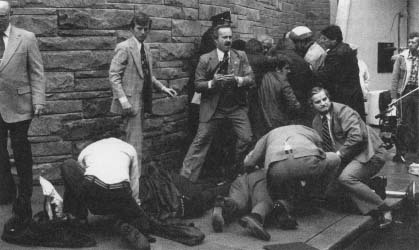
Then came John Hinckley Jr. On March 30, 1981, he attempted to assassinate President Ronald Reagan outside the Washington Hilton, firing six shots and wounding Reagan, press secretary James Brady, and two others. His attack stemmed from a delusional fixation on actress Jodie Foster, whom he believed he could impress through the shooting. At trial, Hinckley raised an insanity defense, and the jury found him not guilty by reason of insanity on June 21, 1982.
The reaction was immediate and furious. Texas State Senator Ray Farabee said the case showed how the defense “erodes trust in our criminal justice system,” Kansas Attorney General Robert Stephan called it “a travesty of justice,” and California Governor Jerry Brown condemned “a legal system that totally disregards the issue of guilt or innocence.” The reaction was emotional, loud, and politically powerful. The case quickly became a rallying point for people who wanted tougher rules, not a calmer debate about the doctrine itself.
There was also real fear among defense lawyers and forensic experts that the response might go too far and end up abolishing the insanity defense altogether. In the end, the system tightened the rules governing legal insanity instead of jettisoning the whole idea. The post-Hinckley reforms pulled the law back toward a narrower, more M’Naghten-like standard.
In the next post, I’ll turn to a particularly difficult kind of legal insanity case: mothers who kill. Those cases often show what happens when law and science seem to be pulling in different directions.
Discover more from Samurai Shrink (formally Wandering Shrink)
Subscribe to get the latest posts sent to your email.

