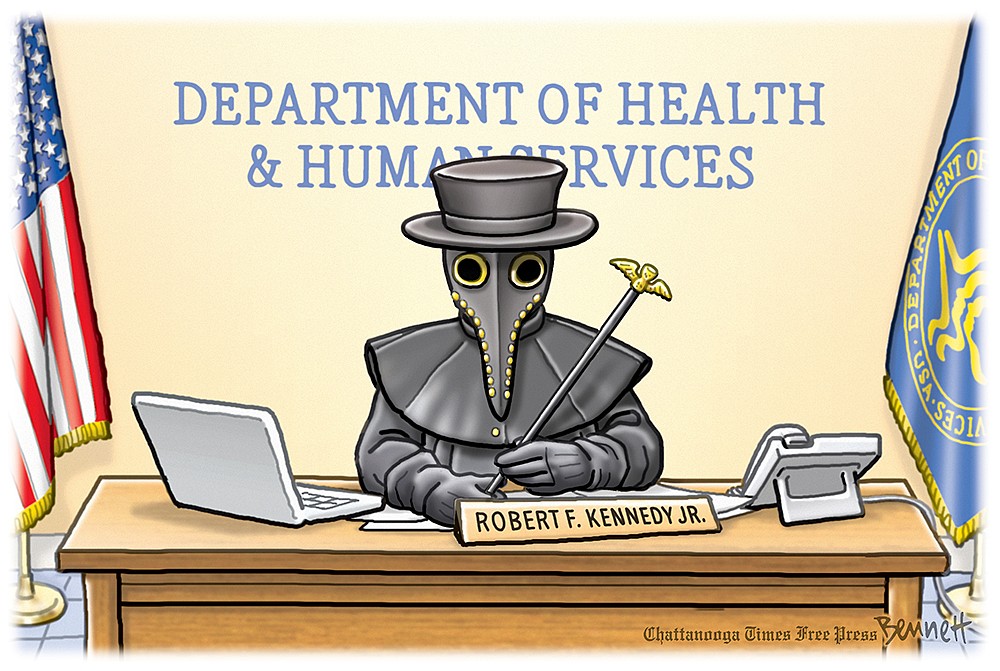
I can’t help but be fascinated by RFK Jr. It’s kind of like driving by a motor vehicle accident-horrifying and yet you can’t look away. Granted, we live in strange times and there is so much to be horrified by that I have to take it in small doses. For years I’ve tried to help my patients try to stop worrying about things over which they have no control, with varying degrees of success. Now I have to keep reminding myself to try and do the same, but I’m not always successful. On reflection, I think I focus on RFK Jr. for several reasons. One of these is that I know something about science; actual statistics and methodology were never my strong suit, but you can’t read journals and attend conferences for 40 years and not pick up something along the way. Also, RFK Jr.’s endless stream of pseudo-scientific crapolla provides both an exemplar and maybe a teachable moment. Have you ever noticed that schools talk about using courses to teach critical thinking but almost never have a course entitled “Critical Thinking 101”? If they made me President for Life, adding that to the curricula would be one of my first executive orders.
In an earlier post that featured a guide to pseudoscience that prominently featured Gwyneth Paltrow, jade eggs, and Cheese Whiz, I did touch on this. The idea is that actual scientists have developed grading systems for scientific claims and the evidence that purports to support them. But it occurred to me that some concepts are difficult to break down for the uninitiated. Ideas like statistical significance, hazard ratios, and meta-analysis aren’t that easy for most people to wrap their heads around, and generally, the average person manages just fine without a deep understanding. I’m no different in many areas. How does electricity work? Where do they get it and how do they send it to my house? And once it’s there, how does it power my TV, let alone allow me to stream movies and TV shows to my living room? I dunno, it’s enough for me that it works; I don’t have to know everything.
But I think that in recent years critical thinking has been in short supply. Not only that, but there seems to be a concerted effort to undercut the very basis of critical thinking. Day after day our Dear Leader and his minions (maybe “lackeys” might be a better term?) basically ask the question “Who you gonna believe, me or your lying eyes?” And some of it comes from the left as well. There, the move is often more subtle, but no less corrosive. When “lived experience” is treated as automatically trumping any inconvenient data, the message is that who is speaking matters more than whether what they’re saying is actually true. And when people start talking about “my truth” and “your truth” as if facts themselves were just a matter of personal taste, it becomes almost impossible to have a real conversation about what is actually going on in the world.
But fear not, your friendly neighborhood Samurai Shrink is here to explain it all, and that’s where RFK Jr. and his merry band of nitwits come in. Their health claims and the “science” they use to support them are almost caricatures of critical thinking and pseudo-science. Let’s begin.
Here are some of the latest RFK Jr. health claims:
- Autism is largely driven by a combination of vaccines, Tylenol (acetaminophen) use in pregnancy or early life, and circumcision.
- Many routine childhood vaccines are unnecessary, and the U.S. schedule should be sharply cut back to a “Denmark‑style” version.
- mRNA Covid vaccines are too risky and poorly tested to justify continued large‑scale investment, so major mRNA and pandemic‑preparedness programs should be defunded.
- There has been a governmental “war on protein” and “war on saturated fat,” now being corrected by new guidelines urging higher protein (about 1.2–1.6 g/kg/day) and emphasizing red meat and full‑fat dairy.
That’s pretty daunting, right? I went out and got the mRNA Covid vaccine, and it was dangerous? I’m not getting enough protein and fat? Is it true? Enquiring minds like mine want to know. For people who didn’t study biochemistry at Stanford, it can feel impossible to tell whether any of this is true. Enquiring minds like mine want to know—without needing a second graduate degree.
So here is a Mart 5‑Step Model: a simple, repeatable way to grade health claims before you panic, change your diet, or skip your kid’s shots.
Your 5‑Question Checkout for Health Claims
Before you panic, change your diet, or cancel your kid’s shots, run any health claim through this quick checkout. If you can’t answer most of these with “yes,” be cautious.
1. Who’s talking, and what are they selling?
- Is this coming from a medical society, public health agency, or independent clinic, or from someone selling books, supplements, courses, or a political identity?
- Do they stand to gain money, followers, or power if you believe this?
If the main product is outrage, fear, or a miracle cure, pause.
2. Can you find at least one strong, independent source that agrees?
- Check one or two “anchor” sources: national health agencies, major hospitals/clinics, or respected medical charities.
- Look to see whether they broadly agree with the claim, strongly disagree, or don’t mention it at all.
If a claim only lives on influencer channels, advocacy blogs, or partisan outlets, treat it as unconfirmed.
3. What kind of evidence is this built on?
Think of a very simple three‑tier ladder:
- Top tier: Many studies summarized together (systematic reviews, big guidelines, consensus statements).
- Middle tier: One or a few decent‑sized clinical trials or observational studies.
- Bottom tier: Stories and opinions (testimonials, before‑and‑after photos, “a doctor I know says…”), or unpublished/preprint work no one else has checked yet.
If everything is bottom tier, the claim is not “settled science,” no matter how confident the speaker sounds.
4. Do they talk about downsides and uncertainty?
Trustworthy explanations:
- Mention possible risks or side effects.
- Admit what’s still unknown.
- Avoid promising 100% success or safety.
Untrustworthy ones:
- Offer huge benefits with almost no risks.
- Lean on “They don’t want you to know this.”
- Treat anyone who disagrees as bought off or stupid.
If there’s no room for doubt, there’s usually a problem.
5. Is the promised effect big, miraculous, or suspiciously perfect?
- Claims that the effect cuts your chances of whatever you are trying to avoid in half need some scrutiny. This often turns out to mean “cuts risk from 2 in 1,000 to 1 in 1,000” , can be important but is modest; “eliminates your risk” rarely holds up.
- Be especially wary of claims that cure most cases of a complex problem, reverse aging, or explain nearly every modern disease in one neat story.
As a rule of thumb, the more miraculous it sounds, the more you should insist on top‑tier evidence, not just a clever narrative.
Now to the grading system. After you run a claim through the 5 questions, give it a color: green, yellow, or red.
The Traffic‑Light for Health Claims
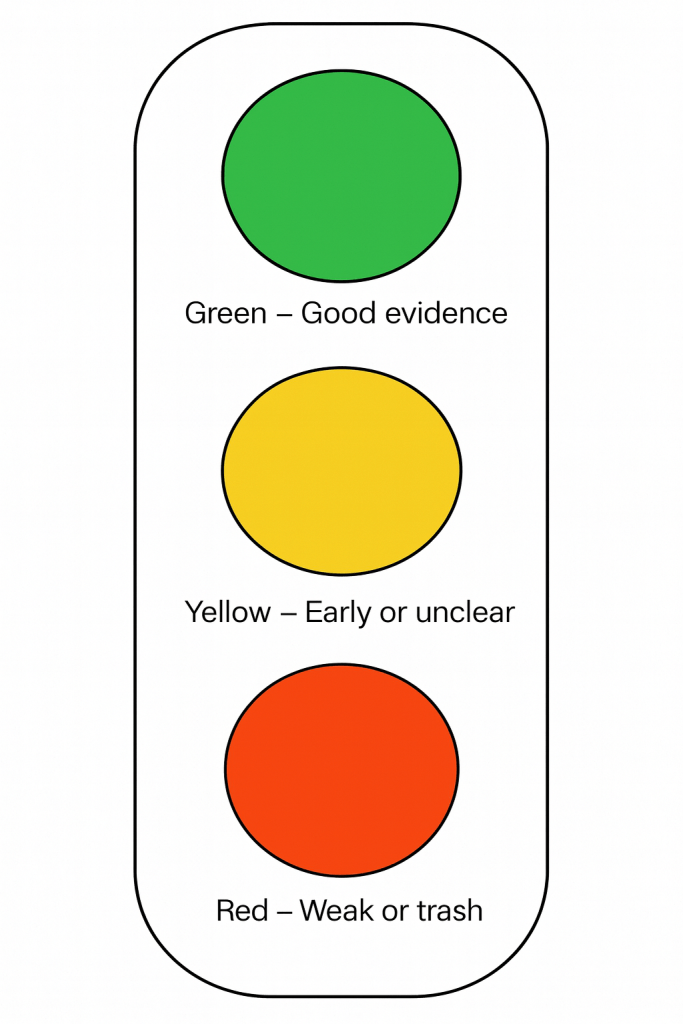
- 🟢 Green – Proceed
“Proceed—this is how good evidence usually looks.”
Use when there is strong, converging evidence; neutral or low‑conflict sources; and a clear discussion of benefits and risks. - 🟡 Yellow – Slow down
“Slow your roll—interesting, but the evidence is early, thin, or has some red flags.”
Use when there are small or limited studies, mixed expert opinion, or noticeable bias/cherry-picking. - 🔴 Red – Stop
“Hit the brakes—this claim is not supported and shouldn’t guide decisions.”
Use when there are mostly anecdotes or conspiracy framing, no credible independent backing, or it contradicts robust existing evidence.
If a claim gets solid yeses on most of the 5 questions, it’s green.
If it’s a mixed bag, call it Yellow.
If almost everything sets off alarms, it’s red—hit the brakes before changing anything important.
Ok, let’s proceed.
Claim 1: Autism from vaccines + Tylenol + circumcision
Color: 🔴Red – Stop (“Hit the brakes”)
Kennedy now suggests that autism is largely driven by a three‑way combination: vaccines, Tylenol use in pregnancy or early life, and circumcision. It’s a dramatic story – and it rests on a couple of tiny, heavily criticized circumcision/autism papers plus speculation about acetaminophen, not on large, replicated autism research.
If you run this claim through the 5 questions, almost everything comes up “no”: major autism researchers and medical bodies do not back it; the evidence is low‑quality and inconsistent; and the narrative promises a simple explanation for a complex condition. That’s classic Red territory: hit the brakes; this shouldn’t guide anyone’s pregnancy care or decisions about circumcision.
(Note: After writing this, something occurred to me that was so obvious I felt stupid for not thinking about it immediately. The data to prove or disprove the circumcision-autism link was staring me in the face. In Israel and most Muslim countries, male circumcision is near-universal. In Sweden, about 95% of the male population is uncircumcised. So, if RFK Jr. is correct, we should see a real difference in autism rates. Is the rate of autism in Israel meaningfully higher than in Sweden? No indeed. The rates of autism do not differ in any meaningful way, with rates of around 1-2% in both populations. So that settles it? Dream on.)
Claim 2: Cut the U.S. childhood schedule to a “Denmark‑style” version
Color: 🟡Yellow sliding toward 🔴Red – “Slow your roll.”
Kennedy argues that many routine childhood vaccines are unnecessary and that the U.S. should copy Denmark’s slimmer schedule. On a podium, that sounds like “common sense”: fewer shots, same safety. Once you ask the 5 questions, the picture changes.
Denmark’s schedule sits inside a very different system: universal primary care, a national registry, extremely high on‑time vaccination, and different patterns of disease. U.S. pediatric and public‑health experts—including some Danes—have warned that simply deleting vaccines here, in a more fragmented, lower‑trust system where coverage is already slipping, is likely to mean more hepatitis, meningococcal disease, flu, and so on.
So this claim isn’t pure conspiracy; there is another country with a shorter list. But when you check the independent sources, context, and potential harms, it lands in yellow trending to red: slow your roll and be very wary of using it as a blueprint.
Claim 3: mRNA Covid vaccines are too risky and poorly tested to keep funding; defund major mRNA and preparedness programs
Color: 🔴 Red – Stop
Here the claim is that mRNA Covid vaccines are so risky and so inadequately tested that the U.S. should pull back large‑scale investment in the whole platform. Kennedy has used that framing to cancel major contracts and research programs in HHS.
Run this through the five questions, and the traffic light stays red. The big independent players—vaccine advisory groups, academic researchers, and international health bodies—generally agree that mRNA Covid vaccines, while imperfect, substantially cut severe disease and death and have safety profiles that look acceptable at a population scale. The “evidence” cited to justify defunding often misreads or cherry‑picks studies that, in context, argue for continued refinement and monitoring, not pulling the plug.
You end up with a claim that contradicts the weight of existing data, overstates risks, minimizes benefits, and is being used to drive high‑stakes policy. That’s Red—hit the brakes.
Another thing to consider is that mRNA vaccines have a great deal of promise for mRNA technology is quickly moving from a COVID one‑off to a genuinely new platform for treating disease. The most concrete progress so far is in the treatment of cancer. Individualized cancer vaccines built from a patient’s own tumor mutations are now showing meaningful reductions in cancer recurrence, especially in high‑risk melanoma and a few other solid tumors. On the infectious disease side, next‑generation mRNA and self‑amplifying RNA vaccines are being pushed for influenza, RSV, and stubborn chronic infections like HIV, taking advantage of how fast these constructs can be redesigned as the virus shifts. Not convinced? Afraid of side effects? Boy, are you going to feel silly when you are dying of melanoma.
Claim 4: The government ran a “war on protein and saturated fat,” now corrected by high‑protein, meat‑heavy guidelines
Color: 🟡 Yellow – “Slow your roll”
Kennedy talks about “ending the war on protein” and “ending the war on saturated fat,” pointing to new guidelines that push protein at every meal—roughly 1.2–1.6 g/kg/day—and give red meat and full‑fat dairy pride of place. There are parts of this that many nutrition folks like: less added sugar, fewer ultra‑processed foods, and more attention to real meals.
But the “war on protein” story doesn’t hold up well under the five questions. The prior guidelines weren’t telling Americans to avoid protein; they were urging lean and plant‑based sources and limits on processed meats and excess saturated fat. Most Americans already meet or exceed basic protein needs, and the 1.2–1.6 g/kg target for everyone is closer to the upper edge of athlete/older‑adult discussions than to a broad consensus for the general public.
So this one is a mixed bag: some greenish elements (real food, less sugar), wrapped in a yellow narrative that oversells high protein and animal fat as a cure for what ails America.
In Conclusion
So how do I wind this up, other than by banging my head on the desk? RFK Jr. isn’t a one‑man apocalypse; he’s a very loud, very shiny example of what happens when charisma and grievance outrun evidence. The specifics—autism from vaccines, Tylenol, and circumcision; the “Denmark‑style” vaccine schedule; and the protein war—will eventually fade. The habits of thinking that let them spread will not.
That’s why your friendly neighborhood Samurai Shrink is rolling out this five‑step checkout. It’s not a biostatistics exam; it’s more like driver’s ed for a world full of intellectual motor‑vehicle accidents. You don’t need to compute hazard ratios at the dinner table. You do need to notice when someone is selling you certainty without receipts and asking you to trust “my truth” over your lying eyes.
If you make that your default script, it won’t just protect you from one health secretary with a persecution complex. It will protect you from the next Gwyneth, the next guru, and the next “merry band of nitwits” who shows up to tell you Cheez Whiz is worse than crack, sell you jade eggs, or unveil a brand‑new theory of everything. In the end, good critical thinking is just another way of saying, “I know when someone is pissing on my boots and telling me it’s raining.”
Discover more from Samurai Shrink
Subscribe to get the latest posts sent to your email.
 Samurai Shrink