
Ok, we made it through X-mas relatively unscathed. It was actually pretty good. My son, his wife, and their dog. Gifts were exchanged, and large quantities of salmon, shrimp, steak tips, mashed potatoes and gravy and mushroom casserole were consumed. This was followed by Kay’s whisky cake and key lime pie, plus several other pies. Speaking as a secular Jew from Cleveland, I admit to being baffled by pie and also by non-Jews’ fascination with it. It’s okay, but I’m not an enthusiast. It’s partly the crust, which seems a bit sandy and gritty to me. I like key lime, but that generally has a graham cracker crust, which I see as an improvement on the usual crust. But as far as I can see, most things you can fill a pie with would be better as a cobbler. I generally avoid sweets; if I’m going to gorge, I’d prefer to take those calories in the form of another slice of prime rib or another turkey leg. But some types of pie mystify me (I’m looking at you, pecan and sweet potato). And the sheer amount—are 4 pies really necessary for 4 people, one of whom really doesn’t eat pie? But it’s their holiday and I guess it’s a matter of to each his own.
And it’s not like my own tribe doesn’t have its peculiarities. When I was growing up, we really did observe plenty of Jewish customs, and some of them were not exactly the kind of things that made for golden memories. A couple of examples? Well, during Passover, we really didn’t eat bread. It was matzah or nothing. For the thousands of non-Jewish subscribers to this blog in at least 4 continents, matzah is a dry, flavorless cracker eaten in lieu of leavened bread during the Passover season.
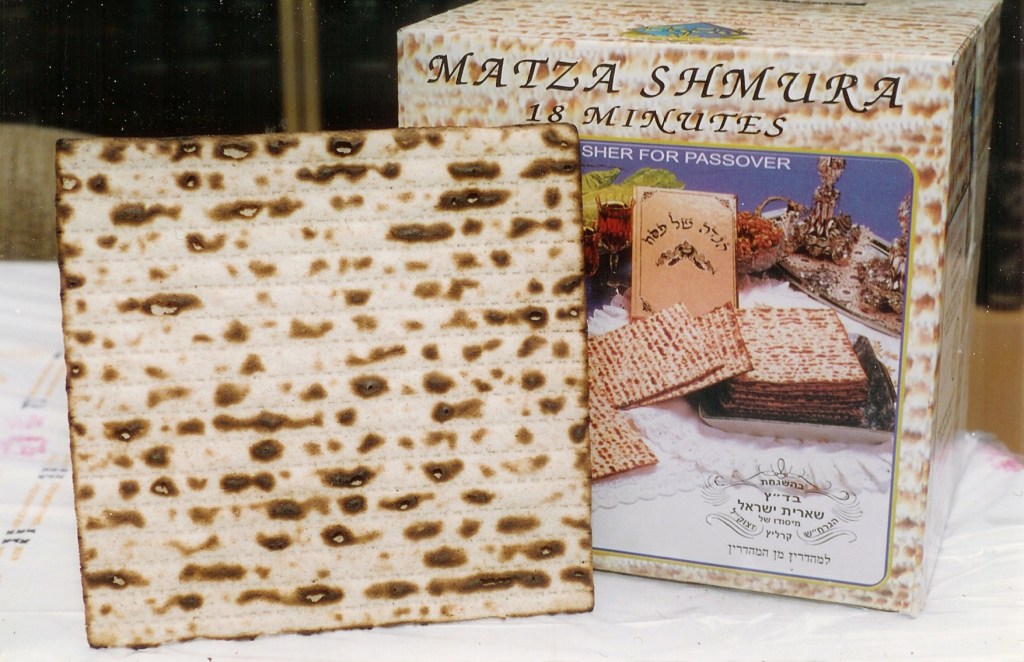
The fact that it is sometimes referred to as “the bread of affliction” in religious texts tells you pretty much all you need to know. I recall taking matzah peanut butter and jelly sandwiches to school for lunch. You bit into them and they disintegrated, leaving you with a handful of peanut butter. And breakfast? My mother would sometimes make matzah brei. She would give the matzah a soak in beaten eggs to soften it and then fry it. It was served with Log Cabin syrup (and there was precious little maple in Log Cabin, buckaroo). A festive dish? Well, for the uninitiated, imagine fried, unsalted saltines dipped in an egg wash and you wouldn’t be far off.
A bit of context. In my family, and the families of most of my friends, all festive dinners were exactly the same. They started with a salad of iceberg lettuce, with some grated carrots and a couple sliced radishes served with Wishbone Italian dressing. This was followed by cold gefilte fish, served with grated horseradish dyed an unnatural bright red with food coloring. Next came chicken soup, served with Buby Lil’s matzah balls. As I mentioned in a previous post, there are two schools of thought regarding matzah balls. One school makes golf ball-sized matzah balls, which tend to be a little lighter and more delicate than the other style. Buby Lil made them about the size of a shotput, and they were not much lighter.
Lest you get the wrong idea, the soup course was my favorite, and when I was a little older, Buby passed her recipe on to me. But after the soup course, you might need a nap.
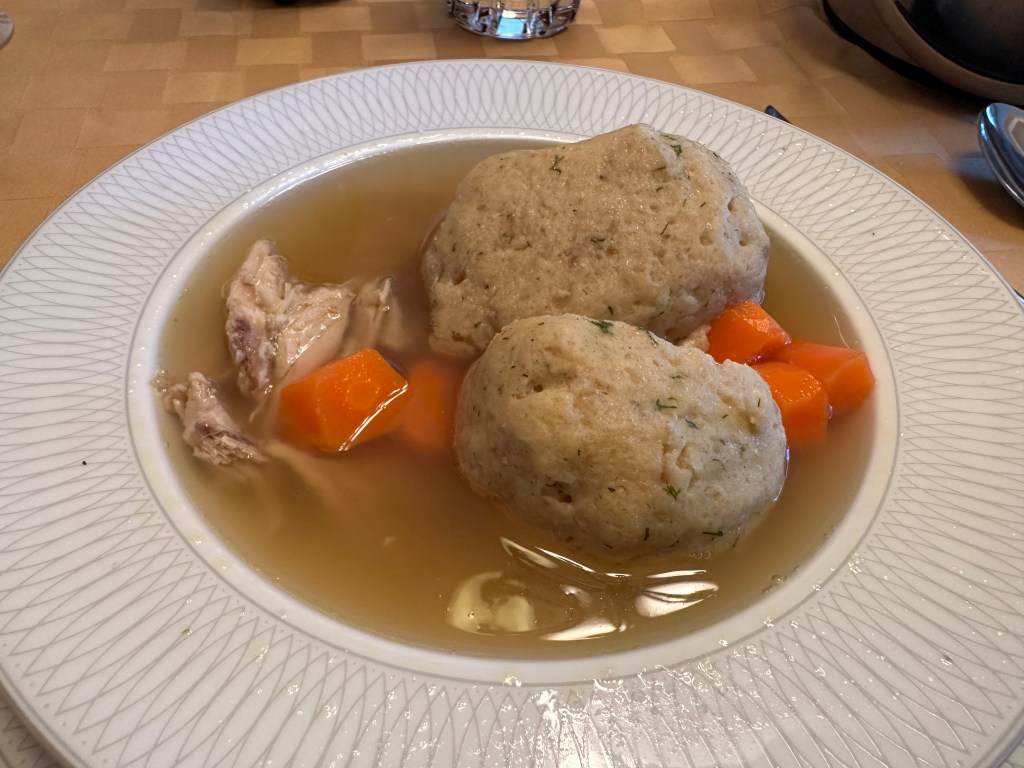
Then the main dishes and sides, which almost never varied. My friend Kraus once referred to this as “the Jewish one-two.” It was always braised brisket and roast chicken. The enamel brisket pot included some carrots and potatoes, and toward the end, the lid was taken off and the potatoes were sprinkled with paprika. Looking back, the only spices I ever experienced back in the day were salt, black pepper, and garlic, usually in the form of garlic salt. This was accompanied by canned green bean casserole made with canned cream of mushroom soup and those strange fried onions that came out of a can. Actually, all vegetables came out of cans; I don’t think I ever encountered a fresh vegetable until I went to college. This was invariably followed by my Aunt Rene’s chocolate cake with sour cream frosting.
I don’t want to give the wrong impression; this was a pretty good meal. Plus, I had nothing to compare it to. But as I got a little older, I began to wonder why the meal was never different. Rosh Hashanah, Passover, Purim, new holiday, same meal. I guess that’s what family food traditions are all about. But there came a time when my horizons began to expand. I went to Beachwood High School and started to have lunch at the cafeteria. They always had mashed potatoes and brown gravy. I assume these were made of dehydrated potato flakes and dried gravy mix, but to me, it was the food of the gods. I had never had actual gravy to that point, and I couldn’t get enough of the stuff. Many years later, I asked my mother and Aunt Rene why we never had it with our invariable brisket and chicken. They seemed baffled, as if I had asked, “Why haven’t we taken Jebus as our Lord and Savior?” They both emphatically told me that these dishes should always be served with natural pan juices.
Years later, I wondered what this was all about. Luckily, I now have an AI research assistant. Here is what we came up with:
- When I was a young Jewish lad growing up in Cleveland in the 60s and 70s, we never had gravy with our food. Brisket, mashed potatoes, or stuffed cabbage were always served with pan juices. It wasn’t until I went to high school that I first had real mashed potatoes and gravy, and it was a revelation.
- That experience tracks very closely with broader mid‑20th‑century Ashkenazi Jewish cooking, where pan juices and braising liquids were the norm and “gravy” in the classic American-diner sense almost never appeared on the table. What you met in high school was essentially another food culture’s way of handling the same components—meat, starch, and thickened sauce—so it makes sense that it felt like a revelation.
- Ashkenazi brisket was typically braised and served sliced with its own juices or with an onion‑rich braising liquid, sometimes later blended and only then described as “gravy.”
- I recall asking my mother and her sister about this and they seemed baffled. “No gravy, natural pan juices!” like the idea was blasphemy. Why was this?
- Their bafflement makes a lot of sense: for women of their generation and background, “natural pan juices” weren’t the absence of gravy, they were the right thing, and “gravy” signaled a different class, religious, and cultural world. Flour‑thickened gravies are a problem for Passover and complicate using the same technique year‑round, so many Ashkenazi families just never built the habit of roux gravies, relying instead on reduced juices or potato/corn starch if they thickened at all. For immigrant and second‑generation Jews, there was often an ambivalence toward fully “American” foodways; sticking with Old World methods felt both authentic and respectable, while thick, gloopy gravies could read as either goyish, low‑class, or just culinarily unsophisticated compared with a well‑reduced jus. Your question may have sounded—without your intending it—like “Why don’t we cook like them?”, brushing against their sense of continuity and pride in the food that had gotten the family from Europe to Cleveland.
So, mystery solved. As an aside, I have been editing my father’s memoirs on and off for the past couple of years. It hasn’t been easy, in part because he also had ADHD and little experience writing. By an amazing coincidence, he wrote about having a very similar experience:
The cafeteria, oh how I loved lunch at Patrick Henry. Other than eating at Gus’ greasy Spoon, I had never eaten out. Now, I got to do it a couple of times a week. Most of the time I brought my lunch, which I made. It was always the same: a kosher salami sandwich and an apple. I did eat it in the cafeteria and often would buy a side of the gourmet cuisine. I’m not kidding; I thought the food was great. Since I had no restaurant experience and no variety at home, eating cafeteria food was a treat. I had my first-ever spaghetti, macaroni and cheese, chili, apple pie, lemon meringue pie, cherry pie and my first taste of mustard and ketchup. Living with my parents was living in Lithuania on Chesterfield. I forgot to mention that we moved to Chesterfield Avenue when I was thirteen. My folks were doing better financially because of the war, which was still on, thanks to the black market. I guess it pays well to steal. I even got my first pair of new shoes, new pants, and a new shirt.
I can’t help but notice similarities in the way we write. First-person story-telling narrative with a touch of humor about our naivete. It’s probably related to the way we spoke and told stories in my family and a certain temperamental similarity. Well, as they say, the apple doesn’t fall far from the tree. But reminiscence aside, I think I’ve cracked “The Mystery of the Missing Gravy.”
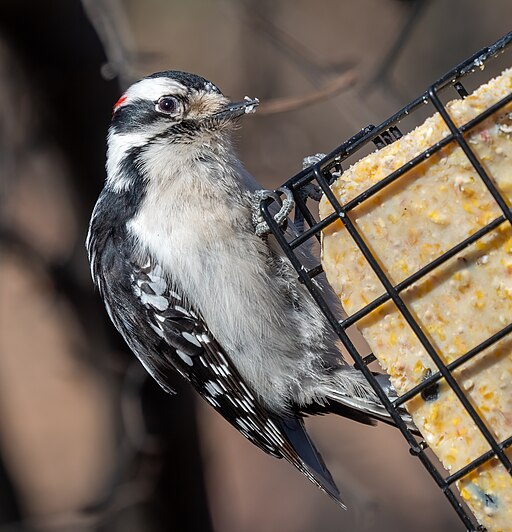
Since this is A Holiday Potpourri, on to the next subject with little or no transition. I may have mentioned that I have a number of bird feeders outside the living room window on the front lawn. I have one large one that holds black oil sunflower seeds. Also, it has a battery-operated squirrel guard. The bird’s perch has a weight sensor. It doesn’t react to birds, but if something heavier, like a grey squirrel or raccoon, jumps on, it rotates and whips them in circles until they decide to let go and seek elsewhere for their meals. I have a couple of other feeders for smaller songbirds and a suet feeder for woodpeckers. Inevitably, seeds fall to the ground and attract large numbers of the wild turkeys that make their homes in some wooded land across the street. There can be as many as 20 at a time; you look out the window, and it’s Jurassic Park out there.
When I was a lad in Cleveland, we had a limited range of birds. It was sparrows, robins, blue jays, and the occasional cardinal. Here in New Hampshire, there is a much wider range of avians. On any given day, I can see:
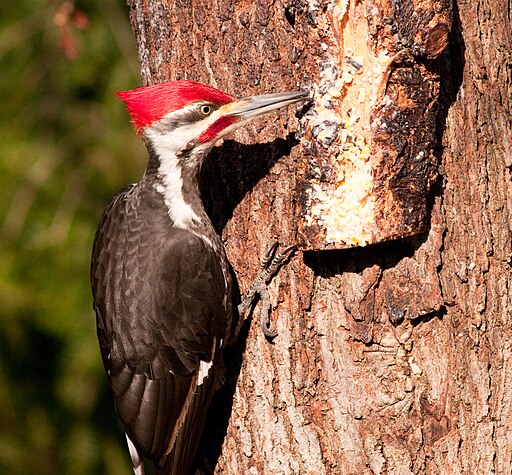







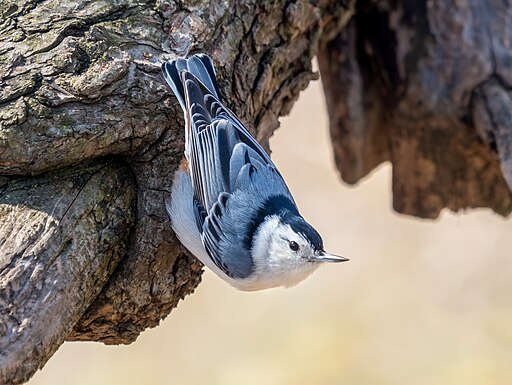


We have also had some rarer visitors. A couple times Pileated Woodpeckers have come to call. The pileated woodpeckers are astonishing. They are up to 19 inches long and have wingspans of up to 30 inches. Unless you hold out hope that the ivory-billed woodpecker is not extinct, they are the largest American woodpeckers. Huh. Hang on a moment while I satisfy my curiosity….
Ok, back. The world’s largest woodpecker that is not likely extinct is the Great Slaty Woodpecker of Southeast Asia, 24 inches long and about a pound and change in weight.

This area of the world is also home to the Malabar Squirrel, which is 3 feet long and can weigh up to six pounds. That’s one big squirrel.

But back to the feeder birds. The Black-Capped Chickadee is a frequent visitor: tiny little grey, black, and white birds. They weigh about half an ounce. I watched and noticed that they would flit back and forth all day, grabbing a sunflower seed and flying into a tree to eat it, probably because they are less exposed. You know me; I began to wonder how many sunflower seeds a chickadee needs a day to keep body and birdy soul together. I did some research and discovered that if they only ate sunflower seeds, they would need up to 250 seeds per day to cover their caloric needs, which is about 70 calories. That’s a lot of tucker for a half-ounce bird.
By way of comparison, I’m about 190 pounds of solid muscle. I need about 2200 calories a day to maintain my weight. But I wondered, what if I had the metabolism of a chickadee? It turns out that I would burn between 16,000 and 24,000 calories per day. Chickadees eat about 60-70 percent of their body weight per day, while humans consume about 1-3 percent of theirs.
I thought about this in terms of Big Macs, the universal standard for human nutrition. If I had the metabolism of a chickadee, I’d need at least 40 of them a day. That’s about 20 pounds. Of course, Big Macs are calorically dense, so that doesn’t line up with 60% of my body weight. What if I were health conscious and ate a Mediterranean-style diet? I’d have to chow down about 35 pounds of grub. And if you are a vegan? Good luck.
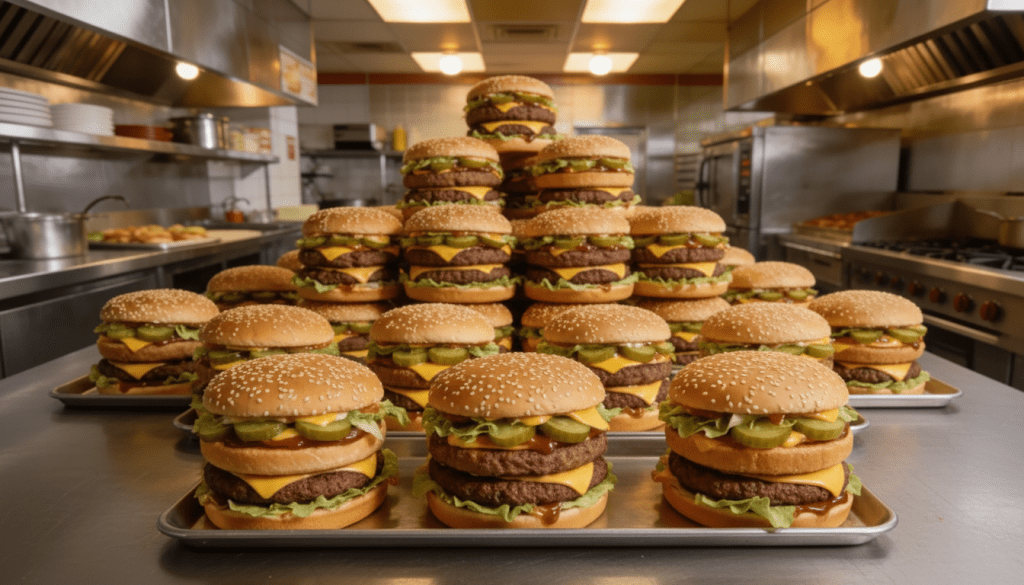
This may explain why so far as I know, the Chickadee tribe had produced no body of literature and no scientific breakthroughs. They are too busy stuffing their beaks to do much else.
Ok, we have covered a lot of ground today and learned many important things, such as the reasons for my mother’s aversion to gravy, the nature of matzah balls, Ashkenazi foodways, and the caloric needs of black-capped chickadees. You are welcome. As ever, I am a river unto my people. Happy New Year, y’all.
Discover more from Samurai Shrink
Subscribe to get the latest posts sent to your email.
 Samurai Shrink