
I’ll admit it, I am an irritable man. Always have been; little things annoy me. I can be quite patient in certain contexts, with children, people with disabilities, that kind of thing. But at other times, I feel like I am going to jump out of my skin. Maybe I inherited it from my parents, who could both be impatient and irritable but in different ways.
Childhood and Family Irritability
My mother was what I would call pan-irritable; everything annoyed her. When I was in 5th grade, my family moved to what would now be viewed as a small McMansion in Beachwood, Ohio. The house had a useless marble foyer with a small chandelier and a half-circular staircase. My room was furthest from the kitchen and den downstairs. If my mother called up to me with a question or request, I would bolt from my room, where I was usually reading, and hustle down the stairs, because if she had to call twice, it was going to be bad. I don’t want to give the wrong impression; nobody beat me with a switch or made me kneel on rice. But if my mother got irritated, it was going to be a very long night in the Mart house.
This got much worse when my mother developed a serious drinking problem when I was about 16. My family would be eating at a restaurant, and my mother would take an irrational dislike of the fingernail polish or the purse of the woman at the next table. She would begin to comment about this, gradually growing louder and louder. Then the other, less inebriated members of the family were faced with a quandary: should we tell Mom to keep it down and have her go off on us, or let things take their course and have a different kind of scene? Well, every family has its little problems.
My father was much more amiable and didn’t look for trouble. But he wouldn’t take any crap from anyone, and he was like a terrier; he might be overmatched in a fight, but you’d have to kill him to stop him. I recall when he was playing in a charity basketball game when I was in elementary school. It was players from the Cleveland Browns against the Beachwood fathers. It was a closer game than you might imagine, as several of the high school dads, including mine, had been all-city and college players. In any case, my father and a Browns player named Jim Kaniki took a dislike to each other and began engaging in a fouling contest. Here’s Jim Kaniki in his prime:

I remember that a couple years later, all the kids wanted a Jim Kaniki football jersey, and their parents wouldn’t let them get them. At the time, I didn’t know why the kids wanted them or why the parents objected.
Perplexity AI tells me that around the time this game took place, Kaniki was 6’4” and weighed 265 pounds; my father was 5’8” and about 175 but was fast as lightning and hard to guard. Matters came to a head when my old man hit a ¾ court shot at the end of the half while Kaniki was guarding him. Early in the second half there was a flurry of activity around center court, and Kaniki and my old man threw some fists. The next thing I knew, they were carrying my father off the court on a stretcher. I asked my dad later why the fight broke out, and he told me that Kaniki felt that my father had been fouling him. Then he laughed and told me, of course, he had been. My old man was perhaps the dirtiest basketball player in history; he was of the school that believes that if you ain’t cheating, you aint trying hard enough. He actually gave me basketball cheating lessons, but since my sporting talents lay elsewhere, I never got to use them.
Misophonia: The Family Curse
Other members of the family have similar problems with irritability. My sister Vivian used to go nuts when her husband or sons would be barefoot and sit with their toes curled (insert pic). And knuckle cracking drove her insane, although I think many people don’t like that. The whole family had misophonia. What is that, I hear you ask? It is an abnormal sensitivity to certain common noises such as chewing, breathing, or tapping. It’s a real thing with a genetic component. With me, it was loud or open-mouth chewing. When I would hear it, my immediate, visceral reaction was to plant my fist in the offending chewer’s face; I’m not kidding. I would sometimes have to simply get up and leave the room. I am informed by Wikipedia that when “confronted with specific ‘trigger’ stimuli, people with misophonia experience a range of negative emotions, most notably anger, extreme irritation, disgust, anxiety, and sometimes rage. The emotional response is often accompanied by a range of physical symptoms (e.g., muscle tension, increased heart rate, and sweating) that may reflect activation of the fight or flight reflex.” True that, Wikipedia.
But I’m cured of that now. How was this cure effected, I hear you ask? Years of psychoanalysis? Brain surgery? None of those. When I was in graduate school, I lived and worked in Manhattan in a group home for developmentally disabled adults. Part of the deal was that meals were included, but they were taken with the residents. Many of these folks had been deinstitutionalized from Willowbrook, that hellhole exposed by Geraldo Rivera. They were a hoot to work with, but their table manners left much to be desired. Some of them had picked up some institutionalized behaviors. For example, one of my favorite residents was an older woman named Shirley. She was a real sweety, but if I didn’t keep an eye on her, she would go into the kitchen and make herself what we called a “Shirley Special,” which was a piece of white bread wrapped around an entire stick of butter.

So I took my meals with the residents, and it was a matter of getting tough or dying. After all, once you’ve watched someone eat a whole stick of butter as an amuse-bouche, a little open-mouth chewing is nothing. I still don’t like loud chewing or slurping, but then who does?
Language Crimes
But back to annoyance. One thing that annoys me is misuse of language. I’m not talking about grammar; the world is full of grammar Nazis, and it seems like everyone who read Strunk and White as college freshmen feels entitled to point out that you are misusing “that” and “which.” The funny thing is that they’re wrong. If you are interested, read the linguist John McWhorter on the subject. He points out that a lot of the rules we learned in college are arbitrary and just someone’s idea of how you should write. I was particularly struck by McWhorter pointing out that as far as English is concerned, we can do away with the whole “who” and “whom” thing with no loss of clarity.
This has nothing to do with annoyance, but McWhorter had an interesting discussion of the way language and expressions develop over time in one of his books, specifically adjective creep. This is the tendency for adjectives, particularly those which express emotional intensity or seriousness gradually lose their impact and become less intense. He gives examples of this. For instance, originally the word “awesome” meant something that inspired fear or reverence; when Moses was addressed by the burning bush, that was probably awesome. “Terrific” used to mean “causing terror”, something that was horrible or frightening such as a terrific thunderclap. Now you hear conversations like “How was the movie dude?” “Terrific, man. And afterwards we went out for pizza at Sal’s. Their calzone are awesome!” So did the movie terrify the viewer, and did the pizza make the diners sink to their knees, overcome with emotion? Of course not but over time saying that the movie was good and the calzone was tasty just doesn’t have the same impact. Of course, you have to wonder what would happen if somebody really did have an experience which caused them terror or awe; maybe they’d have to come up with new words.
With me it’s not grammar; it’s when people say things that just make no sense. I’m not the first one to point this out, but if you are called on stage to make a speech because you just won an Academy Award as best actor, you are not “humbled” by the award. “Humbled” means to be made less proud or to feel less special. If you go out on the wrestling mat and get pinned in 30 seconds, you’ve been humbled. But voted most likely to succeed by your high school class, you might be grateful, but you aren’t humbled. If you think of “humbled” as being similar to “humiliated,” you can see why it makes no sense.
Another one I’ve seen recently occurs when somebody passes away. Inevitably, somebody will say, “We will miss Billy-Bob dearly.” Apparently, many people think this is appropriate, and it means that we will miss Billy-Bob, but we also remember our deep affection for him. This seems awkward to me. When you miss someone, it’s painful; you might miss someone bitterly, but missing them dearly makes no sense to me. I told you I was irritable.
A couple more? Sure, there’s more that came from. How about when you’re talking to someone, maybe the secretary at the doctor’s office, and they ask you, “Do you have a cell phone where we can text you?” You say that you do, and they say, “Perfect!” What’s perfect about it? Suddenly everything is perfect; the fact that I want fries with my burger is perfect, my ordering Italian dressing is perfect, everything is perfect. Where did all this perfection suddenly come from?
Grocery Store & Parking Lot Survival
Moving on from language, I could do an entire volume on people’s behavior in grocery stores and the associated parking lots. Let’s start with the parking lot. There always seems to be a certain percentage of people who prefer backing into a parking space rather than using head-in parking, which is the choice of 90% of the other shoppers. Why is this? Do they feel they might have to make a quick getaway from Market Basket? Does the time spent maneuvering the car backwards into the parking space compensate for the speed at which they will exit? Beats me.
I should preface my next remarks. As my horde of readers knows, I live in New Hampshire, which is tied for the oldest and whitest state in the union, along with Vermont and Maine. Going to the grocery store is like visiting an assisted living facility, and you can only expect these folks to be so alert and spry (notice how I speak of “those folks,” specifically exempting myself).
Looking at some of the annoying behaviors I see at the grocery store, I have to wonder whether this is age-related or whether these people always acted like this. The reason I wonder is that I sometimes see younger people doing exactly the same things, although it’s the elders who do it the most. One of the obvious annoying behaviors is simply parking your cart in the middle of the aisle while you peruse the selection of dried beans, preventing anyone from getting past. When this occurs, I often wait patiently in the hope that the shopper will notice me and move, but that can take a very long time. I don’t get it. It’s an aisle, and its purpose is to allow people to move up and down, grabbing a jar of garlic salt here, a can of tomato paste there, etc. Has the idea of a grocery aisle as a kind of thoroughfare not occurred to these folks, or do they just not give a damn? I may never know. Sometimes when they see me standing there, they seem startled, as if they were thinking, “How did this happen? Why is this person standing behind my cart? “Oh wait, I get it; he can’t get past me. Maybe I should move to the side.” I’ll give these folks the benefit of the doubt, but the folks who just decide to have a gabfest in the middle of the aisle should be drawn and quartered, maybe eighthed.
Then there is the general lack of situational awareness. The grocery store I frequent, like most grocery stores, has this kind of layout:
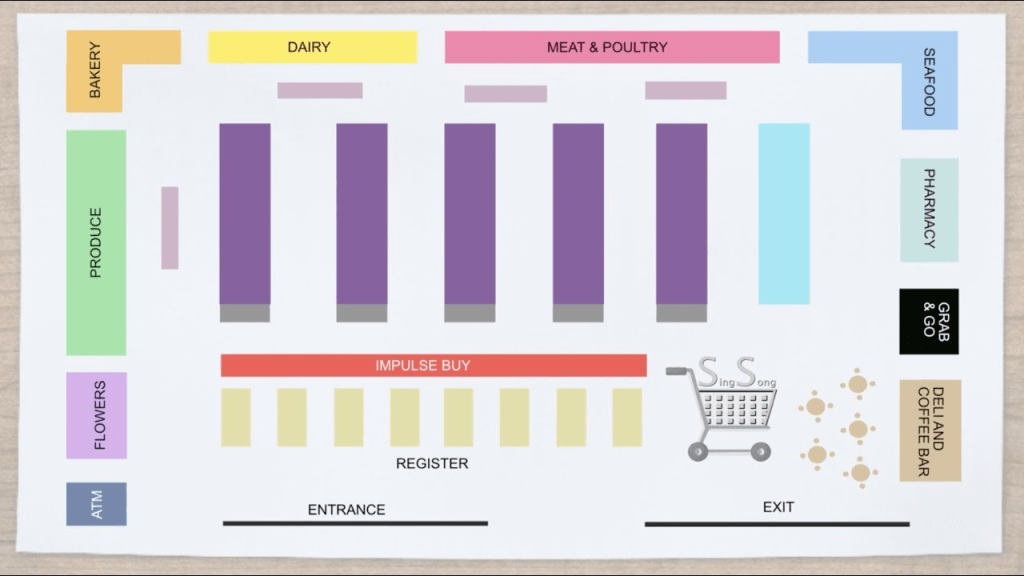
It seems to me that if I was walking up one of the vertical aisles towards the meat counter, I would have some awareness that people were walking from left to right or right to left between the dairy and seafood sections. Apparently, this has never occurred to many people who simply reached the end of an aisle and hooked a sharp left directly into my cart. I hope they don’t do this when driving, but I suspect they may. Again, I don’t know if they are oblivious or simply don’t care, but I find that I have to take evasive action several times during each shopping trip. The same kind of behavior can be seen in the parking lot. I drive a Honda CRV, and I have a rear camera so I can generally see behind me. I look carefully and pull out very slowly because someone inevitably starts walking behind my car while it is moving, often engrossed in conversation with friends or texting a few “LOLs” or “ROFLs” to their chums. Again, are they oblivious, or do they just want to die? As an aside, I should point out that there is never any lack of women, young and old, who leave their purse wide open in the toddler seat section of their shopping cart. It would be no problem at all to relieve them of their wallets while they stand several feet away perusing the cucumbers.
Planet Fitness Protocol
As long as we are discussing local irritants, let’s talk about my gym, Planet Fitness. No real complaints about the gym—cheap, clean, and convenient. Some of the patrons are more problematic. If you don’t lift weights, you might not know that there is a protocol. You have a bunch of people who want to do their routines on a limited number of pieces of equipment. Let’s say you are using the Smith machine to do squats.
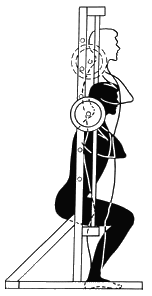
Maybe your routine involves doing 3 sets of 10 repetitions. Under normal circumstances, you rest for a minute or so between sets. The idea is to do your squats expeditiously and move on so the next person can use the machine, and there are a limited number of them. You aren’t supposed to sit on the machine for long minutes texting your bros or BFFs while people wait for you to move it along. And yet, there they are. I’ve backed off a bit, but there have been times when I just stood in front of the guy relaxing on the machine I needed to use and stared at them. Most of the time they get the message and get on with it. But it gets worse. There are those folks who will stake out a machine and actually bring over a barbell or set of dumbbells so they can do another part of their routine while hogging the machine I need to get on. I wonder about the thought process involved here. Do they just feel very special? I’ve mentioned this to the staff and got the distinct impression that they knew this was a problem but didn’t care to have that kind of interaction with the patrons. I get it; they are not exactly living the dream and have better things to do than beef with entitled patrons.
The Dunning-Kruger Curse
In 1999, David Dunning and Justin Kruger identified a particular cognitive bias in which people with limited abilities in a particular area tend to overestimate their abilities, while those with superior abilities tend to underestimate their competence. You’ve seen it frequently, even if you didn’t know that it had a name. Remember your aunt who always brought her special casserole that everyone hated to family dinners? Or your uncle who held forth about his ideas about the current political situation very confidently when it was clear that he had the slightest idea what he was talking about? Or maybe a president who publicly stated, “I know more about ISIS than the generals do, believe me”? That’s the Dunning-Kruger effect. One theory about this effect is that people who are incompetent in a specific area tend to be ignorant of their incompetence, because part of being incompetent involves being unable to tell the difference between competence and incompetence.
One particular example of this kind of thing that springs to mind occurred when I was living in New York. One of my friends from New College, who was one of the most brilliant people I ever met and an expert in philosophy, was chatting with another guy I worked with. When my coworker learned that my friend was a philosophy major, he gleefully quoted the old chestnut, “If a tree falls in the forest and there’s no one there to hear it, does it make a sound?” Then, he sat back with a satisfied look on his face as if to say, “Got you, Mr. Smartypants philosophy major.” My classmate told him that the tree obviously did make noise as it crashed to the forest floor. My coworker seemed stunned and asked how he could possibly know and was even more stunned when my friend pointed out that we had established the tree fell without anyone there to see it, so why did it need his permission to make a sound? I’ll not soon forget the look of confusion and dismay on the face of my coworker who simply could not wrap his head around the answer. That’s the Dunning-Kruger effect for you.
There was a lot of this kind of thing during Covid and the aggressive ignorance persists. We are surrounded by people who haven’t the slightest idea what they are talking about and are absolutely confident in their beliefs. There is a peculiar strain in American public life that is not just willful ignorance but an actual wallowing in it as if it were some kind of virtue. Maybe it has its roots in “the Bible tells me so”? Religion is a particularly effective incubator for ignorance. And lest you think I’m picking on Christianity or Islam. Let me state publicly that the religion in which I was raised had plenty. When I was a graduate student at Yeshiva University, some of my professors were both Ph.D.s and rabbis. I recall one of them explaining to me that if something in the Pentateuch (that’s the Torah, to the uninitiated) didn’t make sense to you, you should just do it anyway until it made sense. There is a classic informal logical fallacy called “begging the question.” You hear this phrase misused a lot and surprise, I find that irritating. Someone will be on the news and say something like, “So we have had 6 bridges collapse in the last 3 months; that begs the question, who is responsible for inspecting these bridges?” In this context, what they mean is “That raises the question.” An accurate example of begging the question is as follows:
“Why hasn’t Eric Mart been awarded the Nobel Prize in science for his work in psychology?” “Because the Nobel Prize committee has not deemed his work worthy of this honor.” Clearly, the Nobel Prize Committee is made up of ignoramuses, if you ask me.
But arguments that beg the question lack evidentiary validity: they fail to provide objective reasons for believing the conclusion is true. In philosophy and formal reasoning, this makes such arguments unpersuasive, as they do not resolve debate—they just obscure the need for actual proof by repeating claims in different language. Religion is full of this kind of thing, as in:
“How do you know that the Bible is divinely inspired?”
“Because it says right in the third chapter of II Timothy that ‘all scripture is given by divine inspiration of God.”
If this doesn’t win the day, you can always fall back on Voltaire’s “I believe because it is absurd,” but then the joke would be on you, because he was being sarcastic. And then there are the ones who think they have open minds and demand to see evidence. I’m going to let Ronnie Cheung field this one. Note: I do my best to keep this blog family friendly but sometimes emphatic language and elevated prose are called for. Ronnie, take it away:
Kind of says it all, right?
So there are many reasons for irritation and annoyance. What’s an irritable man such as myself to do to cope? Well, first of all, let’s face facts. If you fancy that you are a bit above average in intellectual abilities, it is inevitable that you are going to spend a lot of time around people with a little less on the ball. You can’t have it both ways, so maybe you (and by “you” I include me) should develop a little rachmones. What’s that, I hear you cry? It’s a lovely Yiddish word that combines mercy, compassion, and empathy. People are inattentive, inconsiderate, and oblivious at times, and it’s annoying. But are you or I so perfect? It helps to step back and realize everyone is doing the best they can. And as my father once said, “The best you can do is the best you did.” And trust me, we are all going to need a little rachmones at some point. So based on my experience of nearly 50 years as a shrink? Try not to be so easily annoyed.
Discover more from Samurai Shrink
Subscribe to get the latest posts sent to your email.
 Samurai Shrink