
Its about 11:40 AM on Friday the 18th of September, and Kay and I are in the air on our way to NY JFK and thence to Boston. That’s 18 days of travel; I’m not sure we have ever taken this much time off since we’ve been married. Now it’s time for a little reflection; after all, I have 8 hours here in business class to kill. So here, in no particular order, are some of my thoughts on Germany, Austria, and the Alsace region of France.
Let’s start out with a brief schematic to organize my thoughts on some of the more important issues:
| Germany | Austria | France | |
| Food—Dinner and Lunch | Wurst and roast pork morning, noon, and night; dumplings like matza balls, only heavier and gummier (and that’s saying something). | Ditto | German food pretending to be French; you can’t fool me with your tarte flambée, which is sort of like matzah with cheese and little cubes of bacon. |
| Food-Breakfast | Germany has breakfast down. Pasties, as well as all kinds of sandwiches on crusty bread: salami, tomato and mozzarella, fried fish, smoked salmon, and crème fraîche. | Austria, pretty much the same as Germany | The hotel breakfast buffets are identical to the ones in Germany and Austria, all good. |
| Coffee | All of Europe (at least the part I’ve seen) has those amazing giant, improved Nespresso machines. I paid a lot of attention to them. They make you a cappuccino, latte, espresso, double espresso, latte macchiato…you get the idea. And they are at least as good as what you get at Starbucks or Aroma Joe’s. | In addition to the whole enormous Nespresso thing, the Austrians excel at coffee. In addition to using it as a mild stimulant and something to do, they also use it as dessert. | Pretty much the same as Germany |
| Beer | Hands down the winner. Every urban center has a couple major breweries, and their main products are always good. | Similar to Germany, but not quite as good. I didn’t see all that much German beer for sale in Salzburg. I assume it has something to do with national identity, but who knows? | Hit or miss. I didn’t have a bad beer in France, but Alsace is pretty Germanic. |
| Wine | Didn’t try any; was too busy drinking beer | Same as Germany | Top-notch white wine |
A word about the people. I’m enough of a scientist to know that I am working from a ridiculously small sample, given how brief my time in Europe has been and how few people I’ve met. But with that out of the way, I will say that everyone I interacted with in Germany and Austria was invariably pleasant and helpful. Kay is a lot more conscientious than I am (probably didn’t see that one coming, right?) and spent months teaching herself German and French. My language skills topped out at “Danke,” “Bitte,” and “Merci.” I did get a couple laughs with a Germanic-sounding phrase of my own devising, to wit: “Mien Deutch is ferschtunken.” Almost everyone in the EU speaks some English, so it was never much of a problem. But I did notice something. When Kay would try to use her German, the listeners would wait patiently until she started to struggle, then ask politely if she spoke English. This didn’t always happen in France. Some people would give a little eye roll and charge ahead in English. Not most folks, but it did happen. I’m not generalizing, but you have to speak as you find.
A few words of advice on communicating with people who do not speak your language. Here are a few easy steps that have always worked for me. First, just speak English louder and slower; shout if you have to. The second is to simply mime what you are trying to say. This works well if you just want something to eat or a room for the night but can be dicey if you really need to use the bathroom. It can be problematic if the concept you are trying to communicate is a bit nuanced, which is how I found myself doing my version of “the funky chicken” in front of a baffled waiter in Paris on a previous trip while trying to order the coq au vin. When all else fails, just make up your own words that sound vaguely German or French. For example, if you want to say:
“My hotel room is too hot, and I don’t think the air conditioning is working well. Also, what’s wrong with you people? Where is the ice machine? You call this a civilized country?
You could say:
“Ach du lieber! Mein hotelroomen ist machen me to schwitzen, liken un bratwurst in der sonne. Und die aercoolen machtchen nicht vorken! Vas ist wrongen mit euch, strupvaffle? Und wheren ist der Eis-o-mat? Sie namen dis plotz un zivilisiertes gurkenland?”
Works like a charm.
Another thing I relearned on this trip is to know your limitations. On this trip, there were a couple times when my cognitive efficiency declined due to general fatigue, jet lag, and exhaustion caused by excessive sprinting for trains while carrying and dragging a great deal of heavy baggage. If you travel to the same areas, don’t get over-confident because you bought a top-of-the-line suitcase that you can roll through the airport with one finger. You are still going to have to carry or drag it up those three steps onto the train and then lift it over your head onto the baggage rack above your seat. Also, don’t count on the escalators to the train platforms being in working order; I’d say it is a 50/50 proposition.
They often have small elevators, but these have often been used as urinals by previous occupants. I can’t help but wonder why this is so. There have been many times in my life when I had to whiz urgently, and this has occasionally led to some unconventional solutions. But how is it that someone decides that their only course of action is to let fly in a glass elevator that only travels one floor? If this has happened to you, I think it is time to do some serious introspection, because you are obviously not living right, and I think it is likely that you have made many other poor decisions. In the same way, many of the trains had the symbol for “Don’t throw your empty beer bottles out the train window onto the tracks.:
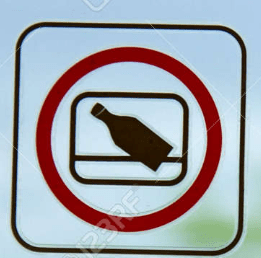
This must happen often enough that they have to post a warning.
When I was fatigued enough that my thinking became a bit unreliable, I made some mistakes that could have had serious repercussions. Thinking I had lost my phone was the first. A second one could have been very serious indeed. Here in New Hampshire, I generally carry an assisted opening pocket knife clipped inside my right pants pocket, perfectly legal. I don’t carry it with the expectation of stabbing anyone, although it’s nice to know that it would be there should the need arise. I use it for opening packages and cutting sausages. But each country in Europe has its own rules. In Germany, it is pretty much verboten, while in Austria you can pretty much carry what you like. For sure you can’t carry it onto a plane in your hand luggage. Before flying out of Frankfurt, I was sure I had placed anything objectionable in my checked bag, but I set the alarm off, triggering a search, and there was my knife in my carry on. OK, I thought, I can buy a new one when I get home. That was when the gate agent told me to slow my roll and called over a policewoman. My blood ran cold when he told me that she had to check the blade length to see if I had committed a criminal offense.
Holy crap, a criminal offense? I don’t think I’d do well in a German prison. Maybe they’d let me slide, and I wouldn’t be jailed awaiting trial, but who knows how long I’d be forced to hang around Deutschland waiting for my hearing? Months? Maybe I’d never make it home. I’d be forced to remain in Germany. I considered my options; I’d open a small business making artisanal kraut, marry a woman named Helga, and wear lederhosen. Luckily, the blade length did not make me a felon, and I was able to proceed home. Walking away from the security zone, I recalled some advice my father had given me on a number of occasions: “Son, don’t be a putz.”
But that wasn’t my last stunt. Kay and I again went through the cattle call they call security at a transfer at JFK. We were putting on our shoes and rearranging our carry-ons when I realized I was missing a few things, namely my passport, wallet, and car keys. I sprinted back to security, and the agent pointed to the tray where I had left them when they told me I needed separate trays for my small Chromebook and my tablet. That’s what 16 hours of air travel and layovers will do to you.
The contrast between EU and US airports is jarring. Don’t get me started about the price gouging we allow in the American airports. Prices are a tad higher in the EU airports, but nothing like what we have here. But it’s more than that. You want a strengthening drink before you get on your plane, which has been delayed several hours? Right this way, to the tune of $12 for a Boston Lager. And you better drink it inside the magic roped-in area because it’s a crime to step outside it. You could sit next to the cable or little barrier and move your hand, holding the bottle back and forth over it: legal-illegal-legal-illegal. What an astonishingly stupid system we have here in the land of the free. It could be worse. Until 2017, Utah required “Zion curtains” in establishments that served alcohol so that customers could not see their mixed drinks being prepared. I’m not making this up. The idea was that the barriers would prevent minors from being exposed to alcohol culture. These days you generally don’t need a barrier, but impressionable children still have to be kept a prescribed distance from the drink prep area. I wondered if they were allowed to see people sipping their martinis once they were served, and they are. Here is what Perplexity AI had to say about this:
- In restaurants, children must be seated at least 10 feet away from the bar or drink preparation area, or a partial barrier can be installed about five feet away with a certain height requirement.
- These rules aim to limit children’s exposure to the preparation and “glamour” of bartending, not general alcohol consumption during dining.
- It is legal in Utah for minors to be present at restaurants where alcohol is served, provided they are not in the bar area or at a table violating the buffer rule.
This rule is apparently driven by LDS legislators, over the objections of many citizens of Utah, business groups and any number of Utah governors objecting to this nonsense. Am I being disrespectful of these legislator’s religious beliefs? Maybe, but let’s let Salman Rushdie field this one:
“‘Respect for religion’ has become a code phrase meaning ‘fear of religion.’ Religions, like all other ideas, deserve criticism, satire, and, yes, our fearless disrespect”.
As long as I’m on a roll here, let’s discuss US security measures at airports. I have thought that it is mostly what is sometimes called “security theather” and it turns out I’m not the only one. Let’s take them one by one.
- Liquids Ban: Restrictions on carrying liquids in quantities over 100ml, implemented after a 2006 plot, persist despite limited scientific backing for their effectiveness. Critics highlight that these bans are largely circumventable and cause significant inconvenience without corresponding security gains
- Electronics Removal: Passengers are often required to remove electronics from their bags for separate screening, a measure seen as reactive and easily defeated by anyone intent on circumventing it.
- Full-Body Scanners: The use of full-body scanners is questioned both for privacy and their actual ability to detect non-metallic explosives, with some experts labeling them “ineffective and easily manipulated”.
- Behavioral Detection Programs (e.g., SPOT): Programs that train agents to detect suspicious behavior or “micro-expressions” have repeatedly failed to identify real threats, with government audits finding no evidence of effectiveness after substantial spending.
- Random Pat-Downs and Profiling: Enhanced pat-downs, especially of children, seniors, and other low-risk groups, are regularly cited as unnecessary and, along with airport racial profiling, have been the subject of lawsuits and public backlash. [Note: When my son was about 6-7 years old, we took a trip to Florida; he was pulled out of line several times for random pat-downs. I can’t help but wonder how many 7 year olds are actually midget terrorists. I’m guessing it was random and coincidential, but as Ralph Waldo Emerson said “A foolish consistency is the hobgoblin of little minds.”]
- Many security responses are reactive, put in place after a particular failed plot (e.g., shoe bomb, underwear bomb), rather than based on comprehensive threat modeling. This leads to a “guess and plug” system that bad actors can easily bypass by altering tactics.
- Studies and government audits have shown that, despite these measures, undercover tests regularly expose significant failures; weapons and prohibited items are frequently missed by screeners, and even with strict protocols, security breaches occur in up to 80% of tests in some years. [Note: Last year the whole mischbocha including my in-laws, the Yratas, went to Seattle and Vancouver. In Vancouver, I bought a 6 inch chef’s knife at Walmart for room picnicing and forgot it was in my sling bag. Did they detect it? No, they did not. I only realized I had it when I got home.]
- Security technologists and some policymakers argue that these measures divert resources from more effective strategies, contribute to long lines, traveler frustration, and even increase public risk by encouraging alternative (less safe) travel modes like driving.
- A significant portion of these measures seem to exist primarily to reassure the public and create an “air of authority,” rather than to prevent actual threats.
It turns out that while there are real threats to travelers out there, the real work takes place in real time via computers and monitoring of big data. Plus, the various “trusted traveler” programs are very effective. TSA knows or should know that Kay and I have 140 years of lawful behavior between us and are very unlikely to have anything nefarious in mind when we jet off to Europe. So, much of the 8 billion dollars spent every year is mostly a waste and lord knows, an enormous pain in the ass. Finally, if some “evildoer” could take over an entire jet with a 2 and half inch swiss army knife or a set of knitting neeedles, this republic is ready to fall.
But be that as it may, we touched down in Boston without further incident. From there we caught the C&J bus back to Portsmouth, and were pleased to see that our car was still there and our house was still standing. Kay and I collapsed and are still reeling with jet lag but I imagine we’ll survive. It will take a little while to sort out all our experiences, but it was a great trip. I have a great life here in Portsmouth. Believe it or not, I still enjoy my work; I make my own hours, work with Kay and probably have the most interesting cases of any of my colleagues. I’ve rediscovered my artistic side and my pottery is finally starting to look like what I have been working toward:

Wednesday nights we get togther at the Tributary brewpub with our mates for uke jam, and who could have guessed I could sing and harmonize on the fly? I can’t help but think of a line from Lord Jim: “‘Yes, my good friend. On that day I had nothing to desire; I had greatly annoyed my principal enemy; I was young, strong; I had friendship; I had the love” (he said “lof”) “of woman, a child I had, to make my heart very full…” Maybe I’m not so young anymore, but I’m still reasonably strong. But I think it is important to shake things up every once in a while and nothing does that like travel. If you are able, go you and do likewise.
Discover more from Samurai Shrink
Subscribe to get the latest posts sent to your email.
 Samurai Shrink