
Despite what you may have been told, international travel isn’t all beer and skittles. Kay and I got up early in Salzburg and caught a cab to the train station. There we caught the train to Stuttgart, where we had to transfer to the Strasburg-Paris train. That’s where it got dicey; we had about 15 minutes to transfer but thought we could make it if we hustled. Imagine our chagrin when the conductor announced that we would be a bit late. To be clear, if we missed that train, it would cause hours of delay, more transfers, and lots of euros lost. It wouldn’t have been so bad, but they had a computer display that would inform us when the delay increased, moment by agonizing moment. One minute late…fine, we can still make it…3 minutes late…still optimistic…ten minutes late…maybe if we run like startled deer. Finally, it became clear that we would miss the connection. We were about to throw ourselves onto the tracks (a quick death is mercy of a sort) when a French couple waiting by the train door with us told us they would hold the train for us briefly. We hit the platform running, dragging our suitcases and humping our packs, and we managed to drag ourselves onto the next train, gasping and sweating profusely. Strasbourg, here we come; our troubles are over!
Except they weren’t. At Strasbourg, there was one more transfer to get to Colmar, our destination. We boarded the local train, shoved our suitcases and packs onto the luggage rack by the train door, and settled in, our seats next to the rack. It was only about 20 minutes to Colmar. The train approached the station, and we got up to collect our baggage.
Have you ever had anything stolen from right under your nose? It’s an interesting and disturbing experience. I pulled down our two cases and my pack. “Kay, is your pack still on your seat?” It was not. Comprehension dawned slowly, and I realized it had been stolen. Kay watched the rest of our luggage, and I stalked the aisles of several cars, blood in my eye. It took me several cars to realize a couple of things: I was disturbing the passengers by striding down the train with my fists clenched looking enraged, and it was more than likely that the thief had entered the car in Strasburg, walked down the aisle, snagged the pack, and exited. That’s what I would have done if I were a thief. So the pack was gone. Nothing that couldn’t be replaced, but enough to be really inconvenient, particularly since the French close everything up on Sundays. We were able to score a case for Kay’s contacts at the one pharmacy in Colmar open on Sunday, but that also involved a good deal of hustling to get there before closing time.
We also tried to make a police report without success. I didn’t have much hope that anything would be recovered, but there were things we could claim on our travel insurance. So Kay trundled down to the police station and was told by the officers that they only took emergency reports on Sunday. That seemed plausible, so Kay went back today in the morning. She was told to come back at 2PM and given no explanation. At that point we tried the website and got nowhere and decided to give it up. I’m going to be careful here; the French are very sensitive about criticism of public officials, and their libel laws are very different from ours in the US. So rather than cast aspersions, let me simply post the response I got from Perplexity AI when I asked:
It was my impression that when I tried to report this to the local police, they seemed rather unconcerned. Am I the only one who has observed this?
Here’s what I got back:
No, many travelers have reported that French police responses to theft, especially on trains or in transit stations, can be surprisingly unconcerned or dismissive. Common experiences include having to wait long periods to file a complaint, officers appearing uninterested, or bureaucratic obstacles that make reporting difficult. Tourists especially notice that police rarely take immediate action and often seem resigned to such losses, given how common these thefts are.
Reported Attitudes and Experiences
- Multiple first-hand accounts describe officers giving minimal attention to theft complaints, especially for tourist luggage and bags, and sometimes making jokes or appearing unprofessional.
- Victims often note delays or being asked to come back hours later, significantly reducing any chance of recovery.
- Online reporting portals pose additional hurdles for non-residents, often requiring French identification or requiring in-person follow-up, which is frequently impractical for travelers.
- Theft is so routine in certain stations (like Paris Gare de l’Est and Gare du Nord) that officers may treat such incidents as inevitable and low priority for active investigation.
So there you go. That’s pretty much what Kay experienced, minus any overt bad manners or joking
As long as I am complaining about the EU, let’s discuss the problem of ice. There isn’t any. In Germany, you can buy a bag at a grocery store, but if you are expecting to find an ice machine in your hotel, you will be sorely disappointed. I can live without it, but Kay really likes her drinks cold. I know this is a stereotyped American thing, but there you are. Kay went down to the bar to beg for some for our portable cooler. She came back to the room with a small bag that held no more than six cubes; they told her that was all they could spare, as they had to conserve their supply for the guests at the hotel bar. I have to wonder, does their ice machine make one cube at a time? I can’t help recalling a National Lampoon cartoon from a million years ago. A couple is at a stall in an Arab market, and the wife is yelling, “Cheese doodles! Cheese doodles! Don’t you people understand anything?”
I’m on a roll here, so let’s continue with this theme even if it’s out of sequence. Today Kay and I got on a hop-on-hop-off bus that goes to various wine-producing towns around Colmar. The bus was hot, and the driver was blasting the radio. It’s a scenic trip but not as good as it could be with Donna Summer belting out “I Need Some Hot Stuff” at full volume. The ride back was even worse. The heat was on despite it being about 75 degrees. It’s hard to enjoy the vineyards of Alsace-Lorraine with the windows fogged up.
Ok, got that out of my system. After many years of traveling, you have to prepare yourself for the fact that not everything will go to plan; as Virgil says in the Aeneid, “forsan et haec olim meminisse iuvabit,” which means “Perhaps someday even these things will be pleasant to remember.”
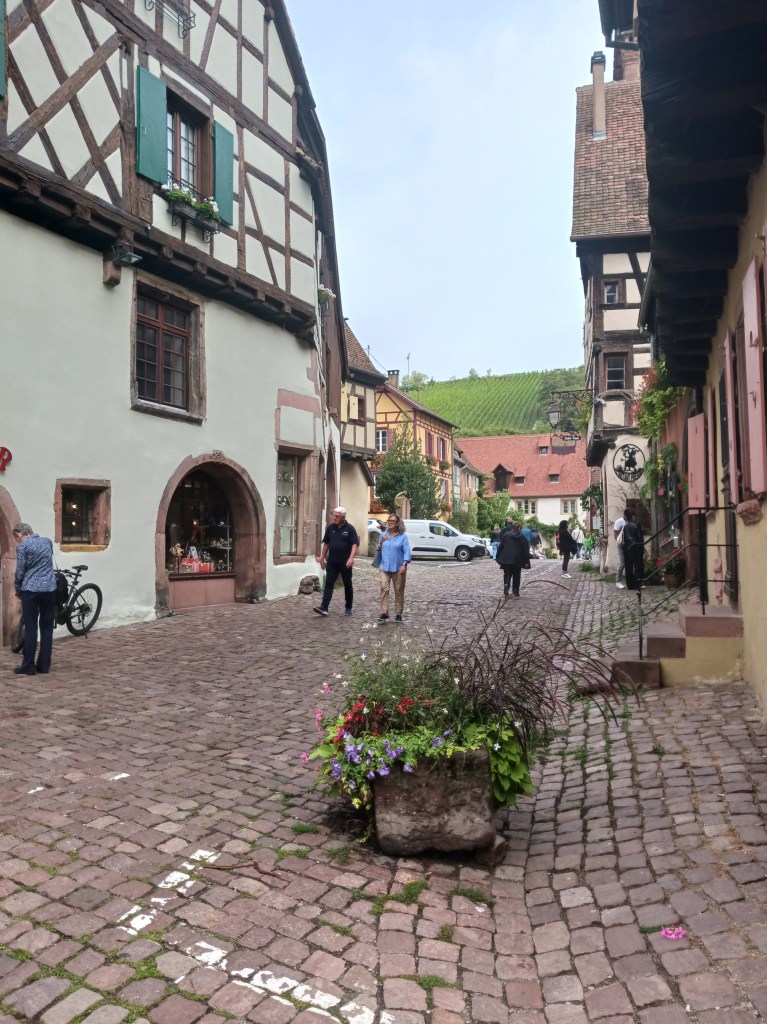
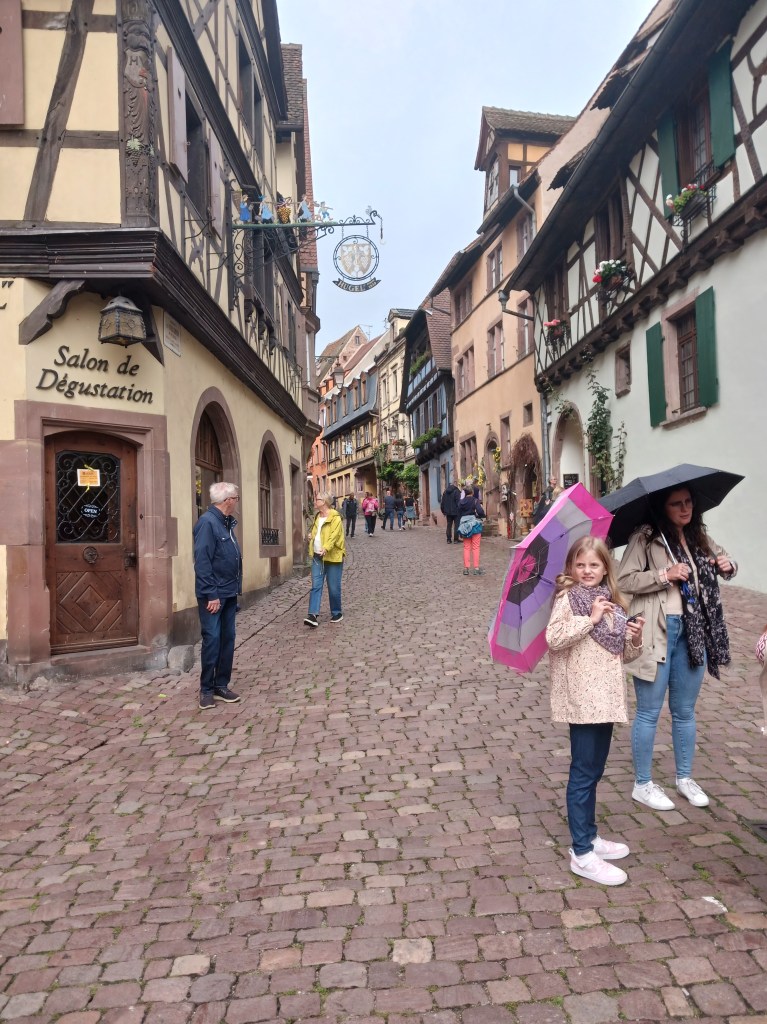
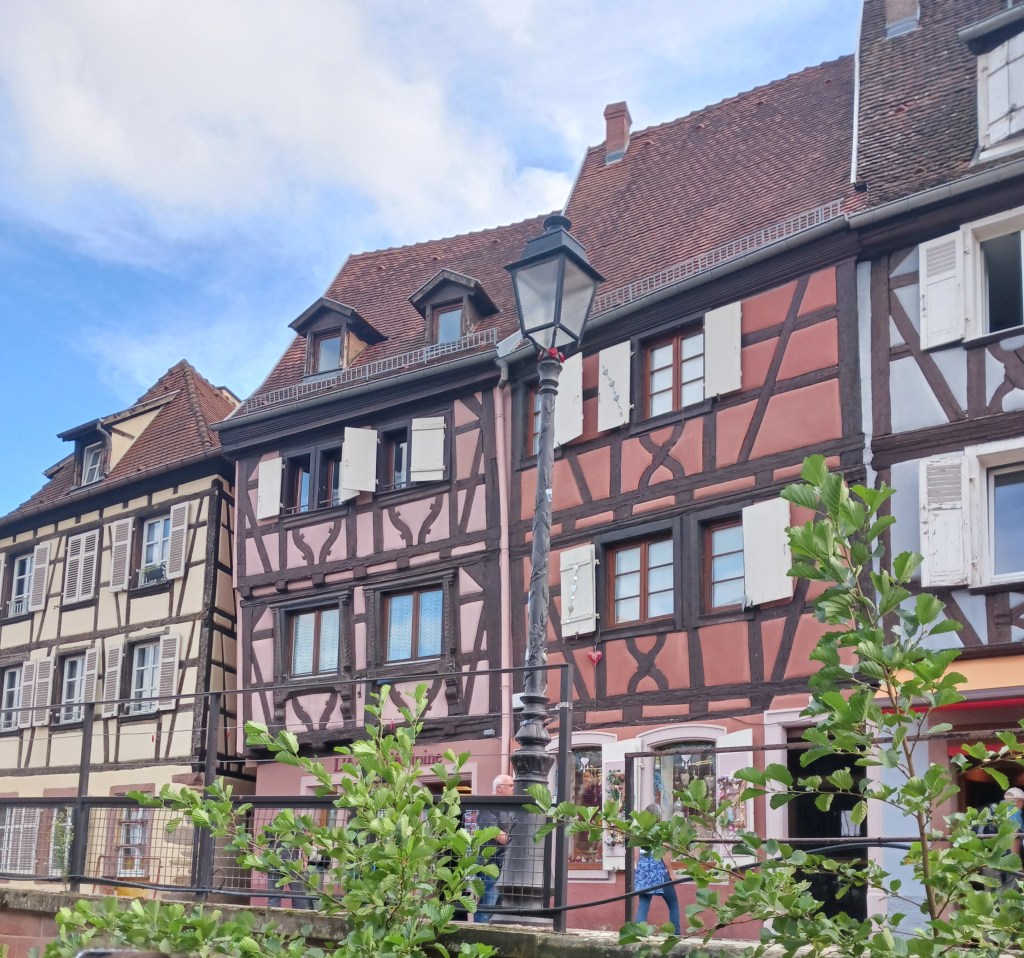
Colmar is a very beautiful city, if a bit overrun with tourists. Here are some samples:

We also enjoyed the wine trail bus that stopped in various small towns nestled in the Voges Mountains; I couldn’t tell one from another, and they were all picturesque.
Kay and I are staying in the Novotel Suites here in Colmar. Nice place, comfortable rooms, and helpful staff. The breakfast buffets here in the EU are way better than the free breakfast you might encounter at the Hampton Inn, where you get what I assume are eggs in the shape of a small yellow hockey puck, hot brown water they call coffee, and some depressed-looking breakfast sausages. Oh, I eat that stuff when I stay there on business trips; it is included, and it is food of a sort. But just this morning, here’s what awaited me downstairs:
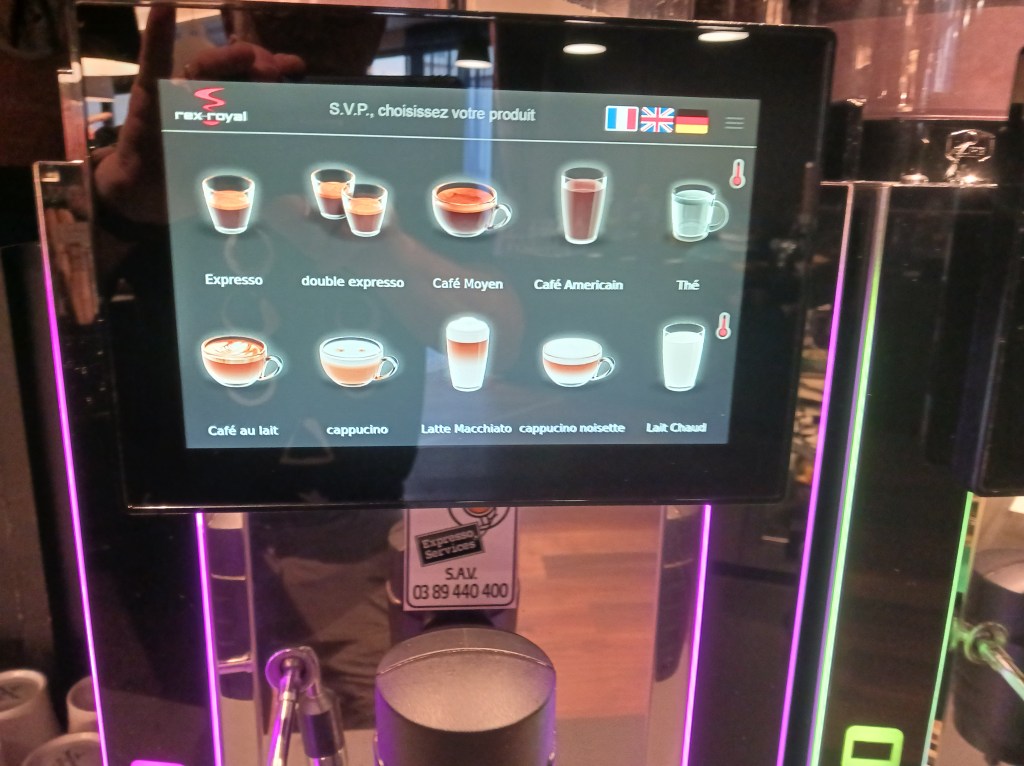
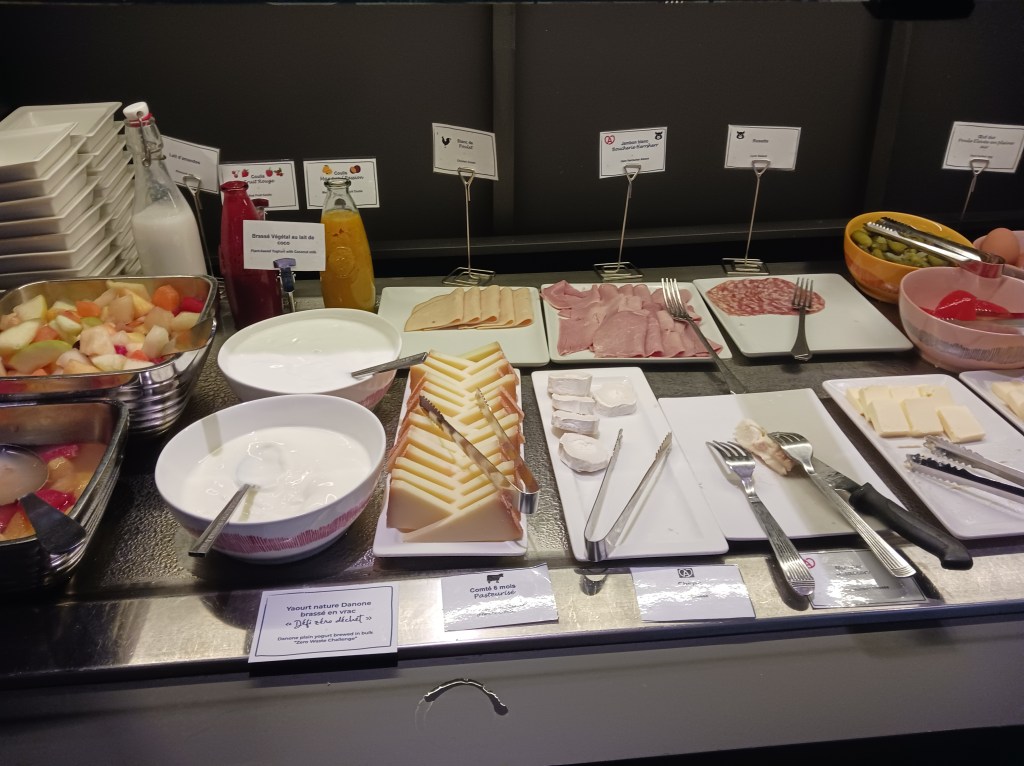
That’s just a small part of what was on offer. They also had scrambled and boiled eggs, several kinds of sausages, at least 5 kinds of bread including fresh baguettes, some kind of local pancakes, a bewildering variety of pastries, fresh juices, leaf teas with infusers, and muesli. And I had three cups of coffee, just to watch the machine work. Why don’t we have this kind of thing stateside? I dunno.
Today I got kind of a late start. Kay was shopping for sundries to replace those lost with her stolen bag. Well, as Shakespeare said in Othello:
Who steals my purse steals trash; ’tis something, nothing;
‘Twas mine, ’tis his, and has been slave to thousands;
But he that filches from me my good name
Robs me of that which not enriches him,
And makes me poor indeed.
Easy for me to say, since nobody has stolen my pack (yet). Kay’s good name is still intact, but I’ve hardly ever seen my diminutive wife this pissed off. It ain’t a pretty sight, and I’m scared, I tells ya, scared bad.
Kay and I rendezvoused in Colmar for lunch. A word about Alsatian cuisine. Maybe not quite as heavy as German fare, but not exactly light, either. Lots of places sell the traditional Tarte Flambée.

It’s like a really, really thin crust pizza topped with cheese or crème fraîche, a variety of toppings, and a scattering of lardons, which are small cubes of fatty bacon or lard. It’s not bad, but give me a slice of NYC-style pizza any day.
In France, they call sauerkraut choucroute and apparently eat a great deal of it. You can order a plate of choucroute garnie, which is kraut with boiled potatoes and sausage, pork, or ham. Not exactly subtle, but a real belly-packer. OK, you get the point; Alsatian cuisine is German food with French names. I’ve also noticed that they don’t sell much German beer; it’s mostly brands like Kronenbourg and Meteor. Pretty good, but not as good as the beers in Germany, which are among…oh, let’s just say it, the best beers in the world. I will be doing another meditation on beer soon which will address such hard-hitting topics as:
Why can’t you get a reasonably priced beer anymore?
Why is beer cheaper than ever, but you can’t get a draft in a pub for less than $9?
Why is it you can get cheaper beer made with adjuncts like rice (Budweiser) or corn syrup (PBR) but there is no mass-market beer like Paulaner or Bitburger in the US that has better ingredients? Why is the choice limited to PBR or a $10 draft at a brewpub in Portsmouth with no intermediate choices? Stay tuned for further posts.
In any case, German beers are good; they should be. After all, the Germans created the most popular beer style in the world.
I just pulled up Wikipedia to check if I was correct in my recollection that German brewers invented a style of light, crisp beer made with malt, hops, and yeast called lager that was fermented at cold temperatures. I was; experts differentiate between variations called “pils” and “Hellas,” but I can’t tell the difference. But I discovered this fun fact. The brewers would create deep cellars and store the beer, along with ice collected from lakes and rivers. But to keep things even cooler, they planted chestnut trees over the cellars; these trees had dense, spreading canopies but shallow roots that wouldn’t penetrate into the cellars. Folks liked drinking in these spots, and why not? Cold beer and shade. This led to the development of modern beer gardens like this one:

Kay and I did some shopping and then took a cruise on a small boat through the canals of Colmar. These canals are small, and the cruise isn’t long, but we had an interesting guide, and the views are picturesque:

I did come across what is known as a contact juggler. Contact juggling differs from normal juggling because you don’t throw the ball (usually a clear acrylic sphere) but manipulate it while holding it. It’s easier to show than explain:
After a bit more sightseeing, Kay and I decided we couldn’t face another tart flambée or plate of bratwurst and kraut. We decided to pick up some bread, cheese, and beer and take it back to the room. Tomorrow we head for Strasbourg, the last leg of our trip before we fly home. Stay tuned for further hijinks and high adventure.
Discover more from Samurai Shrink
Subscribe to get the latest posts sent to your email.
 Samurai Shrink