
I might have to come up with a new category for this blog: recipes. I have a bunch I have collected over the years. I was going through some of my old possessions and found an exam book I bought when I was going to New College, Oxford, back in 1974. Don’t be too impressed; it was a summer program sponsored by Ohio State, and if you had a few bucks, you could go. I literally don’t remember attending a lecture or class. What I mostly remember was drinking in pubs and traveling around the UK. I think the book might be my oldest possession. I used it to collect recipes for various dishes, including curries, stews, and dishes I could make for 20 people when I was working and living in a group home for folks with mild intellectual disabilities on Gramercy Park in NYC.
It also contains several recipes I obtained from my maternal grandmother, Lillian Gaylin, known to her grandchildren as Bubby Lil. She was the perfect grandmother, always pleased to spend time with her grandkids and never in a bad mood. I’d play my Jimi Hendrix albums at full volume, and she didn’t even seem irritated. I loved her matzah ball soup. For those of you who didn’t grow up in a modern shtetl, there are two schools of matzah balls. The first group makes them about the size of golf balls. The other group makes larger ones, about the size of an Olympic shotput; Bubby was of the latter school. Not subtle, but satisfying, and when you ate one, you weren’t hungry for a good long time. She was particularly famous for her brownies, which were known far and wide as “Buby brownies.” When I was an adolescent and developed an interest in baking, I asked for her recipe. She told me that it was just the recipe from the back of the Nestlé chocolate chip bag. I tried it, and they were ok, but not like Buby’s. I’ve tried to figure it out, and my best guess was that she made some systematic error on the instructions—maybe tablespoons of butter instead of teaspoons, a full cup of chips instead of a half cup, something like that. I can’t reproduce them, but I remember the taste, and they were beloved by the stoners at OSU.
One of my recent posts was about beer and its vicissitudes; I’m on a roll here, so I might as well continue in the same vein. I was not a fan of beer early on. My favorite beverage was Coke. I’d drink 7Up and ginger ale, but cola was the real thing as far as I was concerned. But sometime around my 16th year, I discovered alcohol. Back in those days, in Ohio, they had a two-tiered beer system. If you were 21, you could drink what you liked, including full-strength beer. If you were 18, it was legal to drink what was termed 3.2 beer. This was a holdover from prohibition, wherein some states allowed weaker beer as a compromise between the complete banning of all alcoholic beverages and weak beer, which was seen as a step towards temperance. I went off to Ohio State University when I was still 17, so I couldn’t even have a low beer till that November. The idea was that you really had to work at getting loaded on 3.2 beer; that is true, but we were motivated. I recall that across from my dorm there was a local watering spot where that was what was on tap called The North Berg. At the North Berg, you could get a glass of beer or a pitcher. But if you and your buddies were out for a good time, you could get a bucket of beer. This was served in a stainless steel milking bucket that must have held at least a gallon. You would dip your glass in and then play elaborate drinking games. I don’t recall the rules, but it involved much pounding on the table and reciting various phrases. If you missed your cue, the penalty generally involved chugging a beer; since the whole idea was to get plastered, it didn’t make a whole lot of sense, but it passed the time. Trust me, 5 or 6 3.2 beers into the game, you could get pretty blotto, temperance beverage notwithstanding.
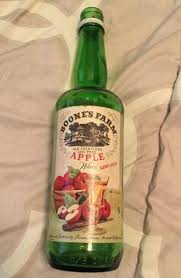
But before that, in high school, the beverage of choice was Boone’s Farm apple wine. It was a sickly sweet, low-alcohol wine that was easily consumed by inexperienced drinkers, much like wine coolers today. Generally, you had to find some older stoner who would buy you a bottle or two for a reasonable tip. Because my pals and I were inexperienced with spirituous beverages, this often led to inappropriate behaviors and a certain amount of projectile vomiting. Good times.
But before I got to this point, I came across some early books on homebrew. These were written in England and called for ingredients such as treacle and demerara sugar, and I had no idea what they were. But I did have a minor brainstorm. I was in the supermarket, and I discovered that they sold 3-pound cans of Blue Star Malt syrup. It wasn’t alcoholic, but it actually included a packet of yeast. Being a thoughtful lad, it occurred to me that I could buy all the malt syrup I wanted and do it myself.

Remember, this was before the internet. You got your information from books you bought or borrowed from the library. In those days, I and my friend Kraus would cut school now and again. Did we go out and raise hell? Sometimes, but usually not when we cut school. We’d hop on the Rapid Transit (Cleveland’s mass transit in those days) and go downtown to haunt the used bookstores. I somehow managed to lay hands on a book on brewing, very primitive by today’s standards. The recipe was a can of the aforementioned Blue Ribbon malt syrup and plenty of sugar. To make very basic beer, you need a primary fermenter, a large vessel that can hold up to 5 gallons. You heat up the malt syrup and sugar till it dissolves, wait till it cools a bit, and throw in the yeast. You cover it with cloth and a lid to let out the CO₂ and keep the bugs out and let her rip. After a few days, the fermentation slows down, and all that yeast starts to settle to the bottom. Then you siphon off the beer and bottle it. That was challenging back in 1972. These days, you can buy a beer capper or plastic bottles with screw tops. These were hard to come by for an adolescent, but necessity is the mother of invention. I was able to save up some screw-on caps. Once the beer has finished fermenting, you siphon it into bottles. But how does it become carbonated? In those days you added a quarter teaspoon of sugar to each bottle and cranked down the cap. The yeast that is still in the beer reactivates and makes a tad more alcohol, and a byproduct is CO₂. It has nowhere to go, so it creates the carbonation. But you have to be careful; if you read much about this kind of thing, you will come upon many stories of people’s fathers and grandfathers who tried their hands at brewing and put too much sugar in the bottles. At some point, the household was awakened by the sound of the bottles exploding in the basement because too much pressure had built up; they go off like bombs and can be dangerous if you are standing too close.
These early experiments led to a lifelong interest in brewing and winemaking. Beer is easy enough to make, and wine is ridiculously easy if you aren’t too persnickety about the taste. The easiest recipe I know is something called balloon wine.

You get some frozen grape juice concentrate, add some sugar, mix it up, and put it in a jug with some yeast—wine yeast if you can get it, but bread yeast will do in a pinch. You tie a balloon around the neck and make a pinhole in the balloon. The yeast starts to multiply, consuming the sugars and converting them into alcohol and CO₂. The pierced balloon allows the gas to escape gradually, and the positive pressure keeps bacteria and other noxious elements from getting to the fermenting juice. After a time (depending on how warm it is), the yeast dies and drops to the bottom of the jug. You siphon it off, leaving as much yeast as possible behind. You can do this several times if you like your wine murk-free. Eventually, you have a stable beverage that has about 12% alcohol. It’s not exactly Châteauneuf-du-Pape, but if you had money for good wine, you wouldn’t be making hooch out of Welch’s grape juice.
This brings me to sake. I’ve always liked it, probably because of its associations with Japan, but also because it’s good. Real Japanese sake comes in many different styles and grades, and they go to a lot of trouble to make the good stuff. When I was in Japan, it was much cheaper than over here. You could get a milk carton liter of the stuff for about $5, and truth to tell, it was as good as any sake I ever had. The Japanese take their sake seriously, and making the real thing is beyond the abilities of most American brewers. But it was not always thus.
Here’s the thing: sake is not technically a wine; it’s a beer, because it’s made from grain. Also, the process is very different from winemaking. If you cooked up some rice and threw in some yeast, it wouldn’t ferment because it is all starch, no sugar. But in Asia, they came at the problem of making alcohol from a different direction. In order to get it to ferment, you have to use a chemical process that breaks down the starch. You need enzymes. In the early days of rice wine, you had women (preferably virgins, but they were not always available) masticate the rice and spit it into a vat. The natural enzymes in their spit did the job of breaking down the starch, but saliva beer was not to everyone’s taste, go figure. Later, they found that some batches of cooked rice that became moldy would break down and ferment. Over time, they started developing cultures of moldy rice that did this particularly well; I’m sure it was an improvement over the chew and spit method. This process is also used in making soy sauce and miso.
Being the inquisitive fellow I am, I did some research about how to make sake. It turns out that if you want to make a beverage that approximates real sake, it’s quite an undertaking and more hassle than I need.

But I wondered, what about Asian farmers or even city dwellers who just want to brew up some easy rice wine? I knew that there were what have been called “farmhouse ales” in Europe for centuries. During the harvest, the farm owners would hire laborers, and part of the deal was that you had to keep these workers plentifully supplied with beer, because laboring all day under the hot sun sure gives a man a powerful thirst, yes indeed. These weren’t the kind of lagers or pale ales we drink today. The farmers used a variety of ingredients they could grow or forage, and the taste was affected by whatever microorganisms lived in the neighborhood. Depending on the farm, you could get many variations, and the beer could have fruity notes or sour tastes; the variations were endless. I did some research, and it turns out that people in Asia have been making the equivalent of farmhouse ale with grains, mostly but not always rice, for many centuries. Every Asian country has some variation.
In Korea, they make makgeolli, a milky beverage with only about 6-9% alcohol, which is low compared to how high in alcohol rice wine can get. My adopted Nepali family, the Katels, introduced me to chhaang, which can be made of rice, millet, or barley. In Nepal, they let the grain ferment, then spoon it into a bamboo tube, pour hot water over it, and drink it through straws that filter out the grain. I did read that in other places nearby, but outside Nepal, they use an herb in the chhaang called aconitum in the same hops with beer.

This can be problematic since Aconitum contains an alkaloid poison, aconite, which just happens to be one of the most toxic substances produced by any plant. It is so toxic that if you touch it, your fingers can go numb. 1 milligram of pure aconite or 2 milligrams of the aconitum plant can kill you in as little as 2 hours, and from what I have read, it’s a very unpleasant way to shuffle off this mortal coil. It starts with numbness of the extremities and progresses to vomiting, palpitations, and heart arrhythmias. Then your skeletal muscles seize up; after that it’s a question of whether you die of cardiac arrest or suffocation. Aconitum is used in part because in Asian medicine, it wards off colds and allergies, makes you “stronger” (we all know what that means in the context of traditional Chinese medicine; I’ll thank you to stop your sniggering), and boosts the immune system. Granted, the people who use it aren’t suicidal; there are ways to make it less toxic. Despite this, plenty of folks have died from the use of this herb in traditional Chinese medicine. Personally, I don’t care how good it tastes; I’ll pass. I didn’t try fugu when I was in Japan, either.
In any case, it turns out that making a decent batch of rice wine isn’t all that complicated. You just need some simple equipment. Wait, before we start, are you of legal drinking age where you live? If not, leave this page immediately. You should be doing your homework, shooting baskets, or playing a video game. Granted, you can see beer at the grocery store or probably in your parent’s fridge. But if you are underage, get lost.
Ok, with that out of the way, here’s what you do. I’d start with about 2 pounds of rice. Most recipes I’ve found call for something called glutinous sweet rice. It’s short-grained and stickier than the rice we are used to. But in my experience, you can use any decent rice—long grain, short grain, brown, whatever. It helps to soak it overnight. Then cook it normally and let it cool, covered. But I’m getting ahead of myself. You need to acquire some special ingredients; you need the whole amylase/yeast thing to get this mass of rice to ferment. The easiest way, in my experience, is to go to your local Asian market and get some of these:

Ask for Chinese rice wine balls. Again, no sniggering. They run about a buck or so for 2 or 3. If you really can’t find them, you could order powdered amylase powder from Amazon, and that works fine, but you’ll need yeast. Bread yeast will do the job. But you could always go to your local brewing supply store if you have one or order wine or beer yeast online. The rice wine balls have both, so it’s one-stop shopping. The problem is that they have the consistency of dried plaster of Paris. I recommend that if you buy some, put them in a plastic bag and take them into the garage. Put them on the concrete floor and beat on them with a hammer until they are more or less powdered. For the 2 pounds of rice I suggested, 2 will be plenty, although you really can’t overdo it.
Now you need a container for the rice. Anything that holds a gallon or two will do. You can use a pot, a crock, or a 2-gallon bucket from Home Depot. You take the cooled rice and ladle it into the container, sprinkling the rice wine ball powder on each layer. You can mix it up with a spoon, but it’s not really necessary. You can buy an airlock to keep the bad microbes out, but it’s just as easy to take a large Ziploc bag or a piece of Saran Wrap and cover the container, tying it loosely with some string. The positive pressure caused by the fermentation forces CO₂ out and keeps mold and bacteria from getting in. Put the container in a warm place and leave it there.
About the second day, you’ll see something interesting. Even though you just had rice and yeast in the jar, now there is liquid forming. The whole mass will start bubbling, and some of the rice will float and some will sink. Some online authorities suggest stirring it every day; some say no. I don’t think it makes much difference.
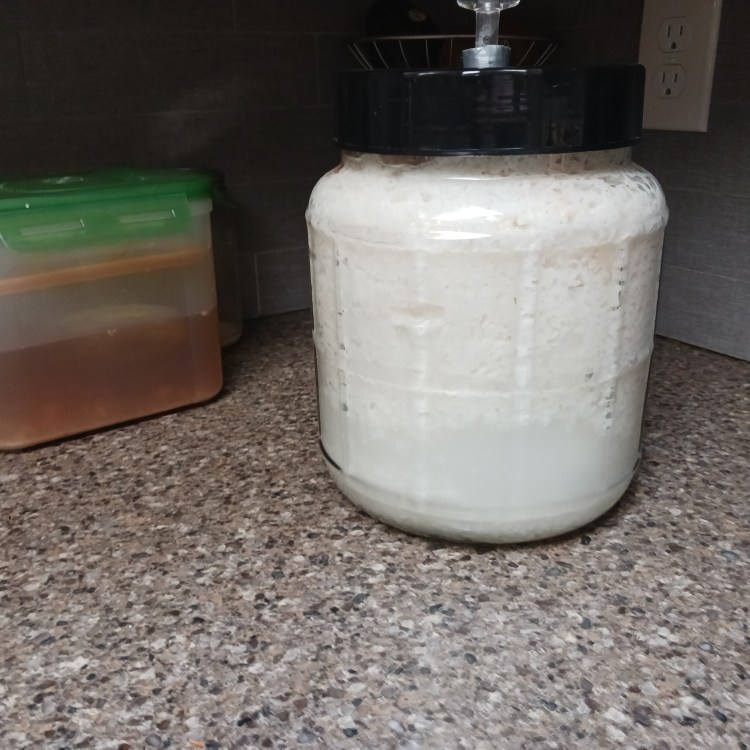
After 4-5 days, get some cheesecloth, a colander, and a really large bowl. Line the colander with the cheesecloth, put it in the bowl, and ladle some of the fermented rice into it. Then gather up the corners of the cheesecloth so you can take the mass of rice and squeeze and work it between your hands. A surprising amount of liquid will come out into the bowl; you can keep it up until you just have a mass the consistency of farmer cheese. This is sometimes called sake lees. You can save it in a jar or other lidded container; the Japanese will bury cut-up vegetables in this stuff for a few days to pickle them. I’ve tried it, and the results weren’t bad. You can also just pitch the stuff, but whatever you do, don’t put it down the disposal, or you will be very sorry indeed. I speak from a certain amount of personal experience on that point.
Eventually, you will have about a half gallon of milky liquid, which is your rice wine. You will need to bottle it. I find that the cheapest and most expeditious way to do this is to get some quart canning jars with lids. But at least early on, keep the lids loose because this stuff is probably still fermenting, and you don’t want glass jars going off like fragmentation grenades in your fridge. You can put it in the refrigerator, and in a day or two, whatever solids are still in it will settle to the bottom of the jar. Depending on your preference, you can just tighten the lid and give it a shake before drinking, or you can pour off the clear wine into another jar, a process known as racking in the wine biz. If you want to age it, you’ll have to stop the fermentation. The easiest way is to pasteurize it by putting the jars into a 160-degree water bath for a bit. You’ll need a thermometer and something to keep the jars off the bottom of the pot, where they would be in direct contact with the hot metal. You can read about the whole process here: https://www.instructables.com/How-to-Master-the-Pasteurization-Process/
Personally, I skip it and just leave it in the refrigerator; this is basically a 2-bottle batch, and I’ll drink it before storage can become a problem. You can drink it cold or hot, but I strongly recommend that you use small glasses or sake cups, because this stuff packs a wallop, yes indeed. It can get up to 20% alcohol, and it doesn’t taste that strong. How does it taste? It varies from batch to batch, but it tends to be a little sweet and tastes a lot like sake, but more robust and a tad thicker. I think a reasonable comparison is that this rice wine is to sake as homemade whole wheat bread is to the commercial product.
It turns out you can use this same amylase/yeast process with anything that has a lot of starch. You could steam some sweet potatoes, regular potatoes, cassava, millet, or corn and add the wine balls. I haven’t tried it yet; if any of my myriad of readers do, please let me know how it turns out.
So what have we learned? Well, there is practical knowledge: how to make hooch out of cheap ingredients. It may serve you well. Come the zombie apocalypse, you may be able to support yourself by fermenting indigenous beverages from whatever fruits and grains you can gather or steal and selling them to the other miserable survivors. Also, there are cultural implications. In the western world, we went the route of fermenting fruits, berries, and honey to get buzzed, while in the east, they used enzymes to break down non-fermentable starch into sugars. This led to soy sauce, miso, and tofu, the mainstays of Asian cuisine. We also learned about the source of aconite and to avoid aconite flavored beverages. And then there is the light amusement of my writing (no, please don’t thank me; your having read it is thanks enough). And as always, I am a river to my people.
Discover more from Samurai Shrink
Subscribe to get the latest posts sent to your email.
 Samurai Shrink