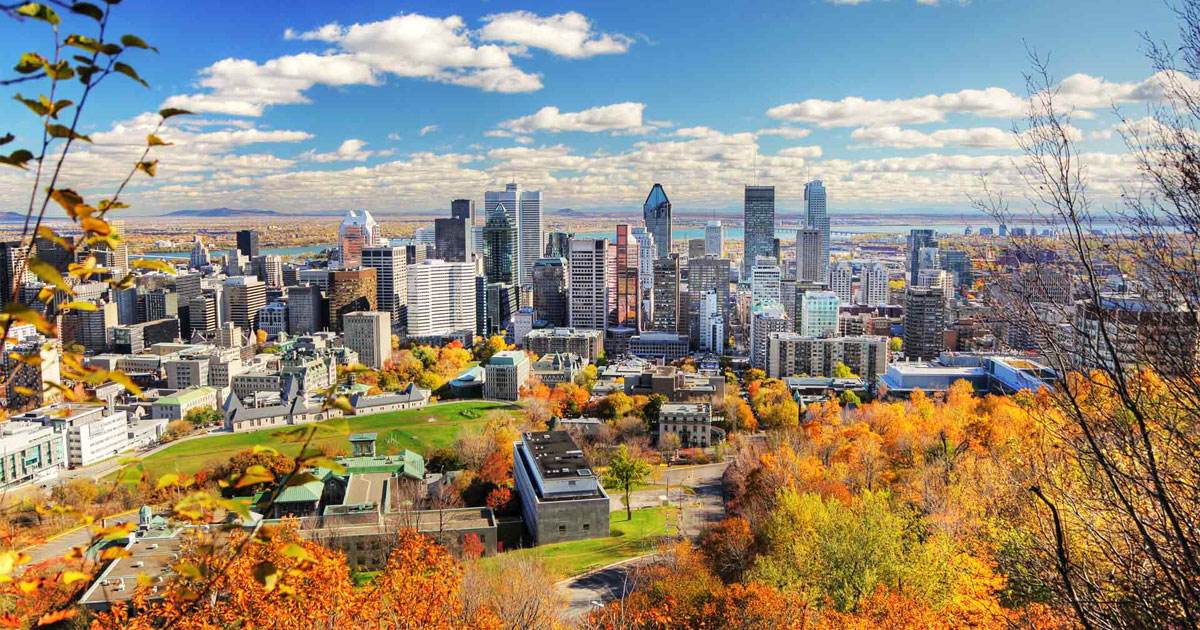
Last weekend, Kay and I spent a few days in Montreal with our friends Liz and Dale. Its a pretty easy drive from Portsmouth, about 4 ½ hours. New Hampshire really has only one major road that goes east and west, SR 101, a 4-lane divided highway. I don’t like driving it for a bunch of reasons. The speed limit is 65, like most highways. I generally keep it under 70 mph; I find that speeding doesn’t really get me where I’m going significantly faster than weaving around and keeping an eye out for speed traps. One of the reasons I dislike 101 is the way people like to drive it. On a typical trip from Portsmouth to Manchester, I’ll be toodling along at 68 in the right lane until I run up against someone doing about 60 for reasons that are not entirely clear to me. I swing out to pass, and inevitably they speed up. It’s not my imagination; I performed some empirical research. I’ll speed up to 70 and hit cruise control so I know exactly how fast I’m going, and the other driver matches my speed. Sometimes I have to go as fast as 75 just to pass and get right. Once I do this, they drop back to a slower speed.
I wondered if this was just me, but I looked it up, and it is an actual thing. Turns out the NHTSA has studied this, and it’s common for slower drivers to speed up when being passed. Why? There are a couple of theories. One is the whole herd mentality thing; drivers generally match the speed of the drivers around them, and in many cases it’s an unconscious process. It can also be a defensive reaction to being passed, which I guess the ol’ reptile brain perceives as a challenge or threat. Either way, it’s dangerous and contributes to accidents.
Adding to this is the fact that almost every time I move out to pass, there is immediately some guy in a giant pickup truck riding my ass, often flashing their lights. This is despite the fact that I’m doing 75 and obviously passing. I have to consciously keep myself from slowing down to 70 to box them in for a while; the old Eric Mart might have done so, but now I realize it just makes an unsafe situation that much more dangerous. Plus, road rage incidents are not unknown on 101, and I don’t need some moron popping away at me with his 9mm pistol. Anecdotally, drivers from Massachusetts are the worst offenders, which is why they are generally referred to as “Massholes” by New Hampshire natives.
Also, the risk of a fatal accident goes up precipitously with increased speed. I know this started as a travelogue, but I’m going to digress further (it’s what I do). The base rate of a fatal motor vehicle accident in 10 years is about 0.072 percent. If you consistently drive around 80 mph for the same 10 years, your 10-year risk goes up to about 0.091 percent. Neither of those numbers is very high, but that kind of speeding increases your chance of a fatal accident over a 10-year period by close to 30%. The research they did to come up with that number didn’t factor in serious accidents without a fatality, so the risk of a bad outcome is almost certainly substantially higher than 30%. So you probably won’t die from speeding, but increasing my speed so I get to Walmart 2 minutes sooner seems like a bad bet to me.
In any case, Kay and I got across the state to Manchester without incident. From there it’s Route 93 north to Concord, where you take 89 to Vermont and thence to Quebec. 89 takes you past Lebanon, NH, home of Dartmouth University. Once you cross into Vermont, the landscape changes. New Hampshire is rockier and craggier; they don’t call it the Granite State for nothing. Vermont is mountainous too, but with more gentle, rolling hills. Every time I drive through the state, I feel like I’m in Middle Earth, although I’ve yet to spot an elf or Ent.
Kay and I did stop at the world’s greatest truck stop/convenience store, a place called Maplewoods. I have dubbed it “The Convenience Store of the Gods,” and it never disappoints.


It’s about the size of an airplane hangar and has multiple food and beverage stations, pizza, sandwiches made to order, and coffee. They have beer, wine, and hard liquor, along with every imaginable style of beef jerky, chips, candy, and plenty of maple syrup products. It’s almost up to the standard of a Japanese Lawson’s or Family Mart.
We stayed a bit outside the city in Longueuil, which was cheaper and just a short ride into town on the Metro. I’ve been to Montreal many times. Let me start by saying that Montreal is a great place to visit. There are excellent restaurants and cafes and lots of funky neighborhoods, and it’s a good place to hang out. There is a long-standing rivalry between New York and Montreal bagels, and I come down firmly on the side of the Montreal version. They are a bit chewier and have a subtle sweetness that goes great with lox. Then there is the smoked meat. It’s presented like a corned beef sandwich of heroic proportions, but it tastes very different. Corned beef is brined and then boiled. Smoked meat is usually dry-cured with salt and spices, smoked, and then steamed until tender. As they say, if God made anything better, he kept it for himself. The hot spot for smoked meat sandwiches is Schwartz’s Deli, located in the Plateau neighborhood.
In 1977, Quebec passed the Charter of the French Language, which made French the official language of the province. This led to some infamous cases involving restaurants that got in trouble for using words like antipasti and calamari on their menus instead of their French equivalents (pâtés, hors d’œuvre, and calmars, if you are interested); the language police could fine you up to $7000 Canadian for each infraction. Matters came to a head when the Italian restaurant Buonanotte was threatened with fines for using Italian words to describe Italian food. This led to the owner going public and caused a huge outcry about the language police and their heavy-handed tactics. This led to other restaurants also squawking, leading to protests and the resignation of the head of the language police. Since then they have been more flexible, but Schwartz’s had to change “Hebrew Delicatessen” to “Charcuterie Hébraïque de Montréal,” and they were not happy about the apostrophe in Schwartz’s either. They also wanted “smoked meat” changed to “boeuf marine,” but that lost traction when Parti Quebecois Member of the National Assembly Gerald Godin stopped by and asked for a smoked meat sandwich by its English name.


I didn’t eat there this time, but I have in the past. The sandwiches are great, but if you eat the whole thing, don’t make any big plans for after lunch, unless you are planning a nap. The place is always crowded; you sit elbow to elbow with the other patrons, and it’s a bit loud. It’s not exactly a relaxing dining experience. My recommendation is that unless you absolutely have to have your smoked meat there, check out some of the other fine delis in Montreal, where you don’t have to force your way in and get up close and personal with the other diners.
Just to be clear, I love Montreal, but it’s not like visiting one of the capitals of Europe; there is nothing there like the Louvre or British Museum. There are a number of interesting attractions, museums, and gardens; the mountain that gives Montreal its name; and Old Montreal. I’m ambivalent about Old Montreal. It has its charms: cobblestone streets, well-preserved architecture, the Cathedral de Notre Dame, and some interesting plazas. But in the summer, it’s packed with tourists and everything that goes along with that, including overpriced mediocre restaurants. Also, all the souvenir shops have exactly the same items. I’d say it’s worth seeing once, maybe twice in the shoulder season.

We did visit an interesting museum in the Old City, the Chateau Ramezay. I’m informed by Wikipedia that the building was built in 1705 as the residence of Claude de Ramezay, who was governor of Montreal. I’m not a conspiracy theorist, but I find it a little suspicious that both the governor’s residence and the governor himself were named “Ramezay.” Coincidence? I don’t think so. You come across this kind of thing more often than you might think. Just as an example, you’ve probably heard the old Christmas song “Here Comes Santa Claus” (Gene Autry, 1947):
Here comes Santa Claus, here comes Santa Claus, right down Santa Claus Lane
Vixen and Blitzen and all his reindeers pulling on the reins
Bells are ringing, children singing, all is merry and bright
So hang your stockings and say your prayers, ’cause Santa Claus comes tonight
Don’t you think it’s a bit of a coincidence that Santa Claus just happens to be on Santa Claus Lane? What are the chances? Also, I just noticed something: the line “So hang your stockings and say your prayers, ‘cause Santa Claus comes tonight.” What does saying your prayer have to do with getting presents in your stocking? Do Santa and Jebus sit down together over mugs of mulled wine and compare the naughty list and the “you are going to spend eternity in the Lake of Fire” list? I always thought they were different franchises, but this suggests that Christmas is like an MCU/DC crossover mash-up. And since I have somehow digressed my way into a discussion of Christmas customs, let’s take a moment to talk about The Elf on the Shelf. For those of you unfamiliar, parents around America buy a figure of an impish elf to sit on the mantle. His function is to keep an eye on the children in the home starting around Thanksgiving and report their relative naughtiness or niceness to Santa. Here’s what the snitch looks like:

Here’s what he’d look like if it were nearing Christmas and I were 8 years old again:

But back to the Chateau Ramezay. It has art, artifacts, and dioramas that present facts about the settlement and development of Montreal. Much of this is not common knowledge. For example, many people don’t realize that before the coming of the Europeans, the indigenous population was quite tiny, not more than 3mm or so:

This made it easier for them to gather resources; one blueberry could feed a village for a week, although it wasn’t easy for them to roll it home.
The Europeans who came to the area were somewhat taller and had advanced sailing craft. This is Le Chanceux Pierre, which sailed up the river to Montreal under the command of the famous French explorer Samuel Champlain. I thought it was a scale model, but the crew of 120 averaged 5 mm in height.

It was touch and go for the colonists, who had to endure the bitter winters and attacks by the miniscule Objibwe. Even starting basic industries was a struggle. It was not until around 1685 that the settlers finally managed to build a working pottery. These are the remains of the first pot ever produced there:

Champlain himself, on seeing this creation, is said to have declared, “Regardez, camarades, on a enfin un pot pour pisser! C’est vraiment un grand jour pour la belle France!”
As the years went by, the residents of Montreal greatly benefited from the plentiful foods they derived from the land by farming, hunting, and fishing. With better nutrition, they now tower above most other populations:

I was able to overhear some of this couple’s discussion :
Étienne, c’est ridicule. Je n’arrive même pas à passer la porte, et j’en ai marre de dormir les pieds par la fenêtre.”
“Comme toujours, tu as raison, mon chou. J’ai repéré un entrepôt abandonné à la sortie de la ville, que nous pourrions transformer en nid d’amour intime.”
I guess even improved nutrition has its drawbacks, but progress marches on.
Liz and Dale had never been to the famous underground city of Montreal, so we took the Metro there. It’s an interesting place, almost 20 miles of interconnected malls, hotels, restaurants, and tunnels all through the city center. There are also long, empty, scary sections of empty storefronts that would make a great setting for a zombie apocalypse movie.
The best part of the trip, as far as I was concerned, was the neighborhoods outside the city center. The Plateau area has a Greenwich Village feel with outstanding architecture and parks. A distinct feature of Montreal city houses is the outside staircases:

I did a little research, and it turns out that in the late 19th and early 20th centuries, laws were passed that required the buildings to be set back from the street to create green spaces. Architects compensated for the loss of square footage by building the staircases on the outside. This also saved on heating costs, since the owners didn’t have to heat stairwells, and also allowed the residents of different floors to have their own private entrances. We also took a breather in one of the local parks:

There was one store in particular that caught my attention; it was an art gallery. I didn’t catch the name, but in my memories it will always be “The Gallery of Really Dysphoric Art.” Here’s a sample of their wares:

There were many more macabre and disturbing paintings and sculptures within. Here’s a travel tip: if you want a hand-carved chair complete with a larger-than-life willy protruding from the seat, you can pick one up at a reasonable price here. I’m sure it will prove to be a real conversation piece.
The drive back to New Hampshire was uneventful. Given the temper of the times, I had some concerns that overzealous immigration agents would drag me out of the car and ship me to Lithuania, but they were professional and polite.
So, Montreal. It’s not France, nor does it wish to be. Not as cheap as it once was, but then nothing is. But it is a great place to kick back, stroll around, drink some excellent beer, and stuff yourself with smoked meat and poutine. Que les bons moments roulent!
Discover more from Samurai Shrink
Subscribe to get the latest posts sent to your email.
 Samurai Shrink