
If you’ve followed my blog, you know that I didn’t get into this to change the world. There I was in Japan, with my little Samsung tablet and a cheap Bluetooth keyboard. On my own on the other side of the world, in the most foreign place I’ve ever been. I wanted to send some pics to my wife and kids, and maybe a little narration. How hard could that be? Harder than I thought, it turns out. I may be the only Ph.D. in America who never learned to type so I peck away with two fingers. The tablet kept flopping over and the keyboard was constantly sliding off the table. I managed to figure out the rudiments of Blogger and got my start posting my thoughts and observations.
The idea was that the blog would be amusing and provide an outlet for whatever creativity I can muster; I’ll leave it to my readers to decide if I succeed. But it was never my intention to use my blog as a bully pulpit. I don’t need the tsuris and death threats, and I don’t think I have much to say about the current threats to our democracy that hasn’t been said already.
But I find that when the subject turns to the administration’s approach to health and science, that’s a different matter. It’s something I know something about and may very well affect me and mine. I read that RFK Jr. had canned the CDC vaccine committee members, not a big surprise really. But then I read about his replacement picks and that piqued my interest. Maybe “piqued” isn’t the right word; I’m thinking depressed, disgusted, angry…you get the idea. They are not all irredeemable shills and quacks, but a number of them have been engaged in plenty of the direst nincompoopery and a general pandering to that particular strain of willful ignorance and paranoia that has always been an undercurrent in American society. Here’s a summary of their claims and positions:
Key Appointees and Their Claims
| Name | Notable Claims or Affiliations Related to Vaccine Safety or Autism |
|---|---|
| Dr. Robert Malone | Has repeatedly suggested, without substantiated evidence, that mRNA COVID-19 vaccines are unsafe and has promoted unproven treatments for infectious diseases. He has also questioned the benefits of measles vaccination and made claims about vaccine-related deaths that contradict public health data |
| Vicky Pebsworth | Board member of the National Vaccine Information Center, a leading source of vaccine misinformation. She attributes her child’s autism to vaccines, specifically referencing thimerosal, a claim that has been thoroughly debunked by scientific studies. Pebsworth has also questioned the safety of the HPV vaccine and has argued that vaccines cause chronic illness and disability in children, another unsupported assertion |
| Retsef Levi | Has claimed on social media that mRNA vaccines cause “serious harm including death,” especially in young people, and called for an immediate halt to their use—claims that are not supported by the consensus of vaccine safety data. Levi co-authored a paper criticized for misleading methods that exaggerated risks associated with mRNA vaccines |
| Dr. Martin Kulldorff | Has publicly questioned the safety and necessity of several vaccines and mitigation measures. Kulldorff has served as an expert witness in lawsuits alleging harm from vaccines and has been associated with anti-vaccine rhetoric, although he has not directly claimed vaccines cause autism. He has also advocated for policies that public health authorities consider unethical and unsupported by evidence |
| Dr. Joseph Hibbeln | Co-authored research examining possible links between maternal fish consumption (and thus mercury exposure) and autism, but did not find an association between mercury levels and increased autism risk. He has no professional background in vaccines and has not directly promoted vaccine-autism claims |
| Dr. Cody Meissner | Generally regarded as a vaccine proponent and has not promoted unsupported claims about vaccine safety or autism. He has, however, opposed COVID-19 vaccine mandates for children and pregnant people, aligning with more cautious or skeptical perspectives on newer vaccines |
| Dr. Michael A. Ross | No publicly available record of unsupported claims about vaccine safety or autism. His background is in obstetrics and healthcare technology, not vaccine research |
| Dr. James Pagano | No documented public statements or research on vaccine safety or autism |
So as a group, they are either spreading dangerous misinformation or have little experience in vaccines or public health policy. I don’t know about you, but this bunch does not make me feel very confident about their ability to deal with the next serious Covid variant or some new epidemic. This all makes me wonder, when did medical progress start being seen as a force for evil?
Once again, I think a little context may help. Back in the late 1700s, smallpox was a major killer; it’s estimated that up to 400,000 people a year in Europe died. The mortality rate overall was up to 60%. The mortality rate for children was even higher, with up to 80% of those contracting the disease dying. And if you were lucky enough to survive, you could go blind or be permanently disfigured. It was far worse when Europeans came in contact with the indigenous peoples of the Americas, where the mortality rates were up to 95%. In some places, a technique called variolation was sometimes used. This involved exposing healthy individuals to material from smallpox sores. It sometimes caused a milder smallpox infection that conferred protection against the more virulent effects of the disease but it could also cause a full-blown case with fatal consequences.
Enter Edward Jenner, an English physician who practiced at the turn of the 18th century. He noticed that milkmaids often contracted cowpox, which was similar to smallpox but much milder, and seemed to be immune to smallpox. In 1796, Jenner inoculated the 8-year-old son of his gardener with material from her cowpox sores. The boy developed a mild illness but quickly recovered. Later, Jenner deliberately exposed the boy to smallpox, but he did not become ill. Granted, this kind of experimentation probably wouldn’t be allowed today on ethical grounds, but it was a tremendous breakthrough.
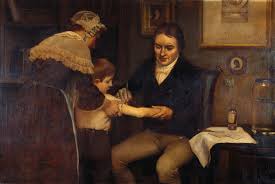
Jenner named the procedure “vaccination” based on the Latin “vacca” meaning cow, a nod to cowpox. After some initial skepticism, the medical community adopted the procedure, and by 1980, the WHO had declared the disease eradicated. Some authorities have suggested that Jenner’s invention of vaccination saved more lives than any other medical intervention in history. I suspect that when many of your neighbors are dropping in their tracks from smallpox, you probably wouldn’t have the luxury of vaccine skepticism.
But at this point in history, people still didn’t know what caused infectious disease. They thought that “miasmas” (bad smells) might be the cause, which is why you see those strange pictures of “plague doctors” in history books.

They didn’t dress up like this to scare people; the long beak-masks were stuffed with fragrant herbs to ward off the disease-causing miasmas.
Fast forward to France in the mid-1800s. Louis Pasteur was born in Dole, France, not far from Switzerland. After completing his doctorate in sciences, which he earned from the École Normale Supérieure in Paris in 1847, he went on to have an astonishing career in biology, microbiology, chemistry, math, and physics. He helped develop germ theory, and as a result, he created vaccines for chicken cholera, anthrax, and rabies. There were lots of steps between, but Pasteur was one of the first scientists to understand that harmful microorganisms caused infectious diseases. Before that, scientists believed that diseases simply arose from miasmas or rotting flesh. That being the case, why sterilize your surgical tools, use antiseptics, or even wash your hands? That’s why surgeons used to operate in blood-caked frock coats; as a result, gangrene and sepsis were common, and there was a 40% mortality rate from major operations. Lister became familiar with the work of Pasteur and began to use dilute carbolic acid to sterilize dressings and clean the operating theater. Surgical mortality rates dropped from 40% to 3%.
Meanwhile, back in Paris, Pasteur continued his work and found that pathogenic bacteria could be weakened or attenuated by various means. Using this technique, he produced vaccines for anthrax and rabies. Rabies comes up in the US more than most people think. About 60,000 people a year get bitten by a potentially rabid animal, most commonly bats, raccoons, skunks, and foxes. If you get treatment right away, you’ll be fine, but if you wait till symptoms appear, you are a goner. The virus travels to your brain, and you develop agitation, confusion, and seizures before you lapse into a coma and die. There are only a few recorded cases of anyone surviving without the vaccine. Funny thing, I don’t think I have ever seen a news story about any anti-vaccination folks refusing rabies treatment and dying, go figure.
Pasteur’s work was groundbreaking in other areas that affect your day-to-day life. Enjoy an occasional glass of wine or a cold beer? Until Pasteur came along, brewers and winemakers didn’t really know why grape juice and malt sometimes turned into wine and beer and sometimes became vinegar. Once again, they thought that whatever made the wine sour just happened. Pasteur showed that it was exposure to specific bacteria that spoiled the beverages and that by using the right yeast and keeping the brewery or winery clean, you could reduce spoilage and produce a more consistent product.
Then there is the process of pasteurization, which for reasons I find incomprehensible, has become controversial recently. When you pasteurize food or drink, you hold it at about 160 degrees for 15 seconds, then cool it rapidly. This destroys any common pathogens while leaving the nutrients intact; there is a slight reduction in B vitamins, but if you are worried about that, go have a beer, a good source of vitamin B. The upside? You don’t contract Campylobacter, Salmonella, Shiga toxin-producing E. coli (STEC), and tick-borne encephalitis virus.
While I strive to keep this blog tasteful, I think there is a point I need to make here. Advocates for raw milk believe that pasteurization kills important nutrients and degrades the taste of milk. But in the EU, where raw milk is readily available, there are hundreds of cases of raw milk-related disease each year. It’s a low risk, but it’s there. And if you get one of these diseases, you’ll probably wish you had stuck with the pasteurized product. Here’s what could be in store for you:
Campylobacter Infection
- Diarrhea (often bloody)
- Fever
- Stomach cramps
- Nausea or vomiting (sometimes)
- Symptoms usually start 2–5 days after exposure and last about a week
- Complications can include irritable bowel syndrome, arthritis, and, rarely, Guillain-Barré syndrome (a nerve disorder that can cause muscle weakness or paralysis)
Salmonella Infection
- Diarrhea
- Stomach (abdominal) cramps
- Fever
- Nausea
- Vomiting
- Chills
- Headache
- Blood in the stool
- Symptoms usually develop 6 hours to 6 days after exposure and last a few days to a week
Shiga Toxin-Producing E. coli (STEC) Infection
- Diarrhea (often bloody)
- Stomach cramps
- Vomiting
- Sometimes a mild fever
- Symptoms typically start 3–4 days after infection
- In severe cases, it can lead to hemolytic uremic syndrome (HUS), a serious kidney complication, especially in children
Tick-Borne Encephalitis Virus
- Many people have no symptoms
- Initial symptoms: fever, headache, vomiting, weakness (incubation is 7–14 days after tick bite or exposure)
- Severe symptoms (in some cases, after a brief recovery): confusion, loss of coordination, difficulty speaking, weakness in arms or legs, seizures
- Can cause meningitis (inflammation of membranes around the brain and spinal cord) or encephalitis (inflammation of the brain)
So how does raw milk come to contain these pathogens? I’m going to give it to you straight. Think about dairy cows; surely you have seen one at some point. Now think of the location of said cow’s anus relative to their udders and factor in gravity. Milk is often contaminated with bovine fecal matter, which contains all manner of nasty things. Pasteurization kills them. But if you prefer your milk straight up with a bit of raw manure, just be aware of the associated risks.
I think people lose sight of the fact that until the middle of the 19th century, there was very little physicians could do about infectious diseases. They were reasonably good surgeons, but if you came down with a contagious disease, you were pretty much out of luck. But due to the work of Pasteur, vaccines for tetanus, whooping cough, tuberculosis, typhoid fever, cholera, and the plague soon followed.
Again, let’s get a little perspective on this. It is estimated that in the 18th and 19th centuries, at least 100 million people died of infectious diseases that are now controlled by vaccines. An argument could be made that the introduction of germ theory and the vaccines and hygienic practices that followed may be the greatest achievement of science. Landing on the moon was pretty impressive. Internal combustion engines made travel and commerce much easier and more profitable, and who knows where AI will take us? But for my money, germ theory, vaccines, and infection control did more than anything else to alleviate human suffering and increase life span and precipitously decrease infant mortality. Here’s a concrete example: in the US in the 19th century, it is estimated that there were 18-30 infant deaths per 100 births. By 1950, the rate of infant mortality dropped to 3 per 100, and by 2000, it was less than 1%. Granted, it wasn’t all vaccines; the discovery of antibiotics had a great deal to do with improvements in health.
I’m old enough to remember when a terrifying disease was brought under control by a new vaccine. When I was a child, polio was a real threat. It became a serious problem in the early 20th century. In 1916, there was an epidemic in New York City, causing 2000 deaths there and 4000 more in other locations around the country. The rate of infection increased over time, and by 1952 there were 20,000 cases of polio reported.
Polio, or more accurately poliomyelitis, is a highly contagious viral disease. It targets the nervous system, particularly the neurons that control the muscles of the legs, and less commonly the head, neck, and diaphragm. The diaphragmatic muscles are the ones that work the lungs and allow us to breathe. As with a lot of other diseases, a large percentage (about 70%) of people who contracted it had no symptoms, and another 25% would just develop sore throats and a low fever. But about 1 percent of those who contracted the disease developed full-fledged paralytic poliomyelitis. This led to withered limbs, muscle weakness, and inability to breathe without assistance; 2-10% of the people who developed paralytic poliomyelitis died from the condition.
Unfortunately, medicine at the time could do very little for the condition. Some of the people who had difficulty breathing were placed in what was sometimes referred to as an iron lung.
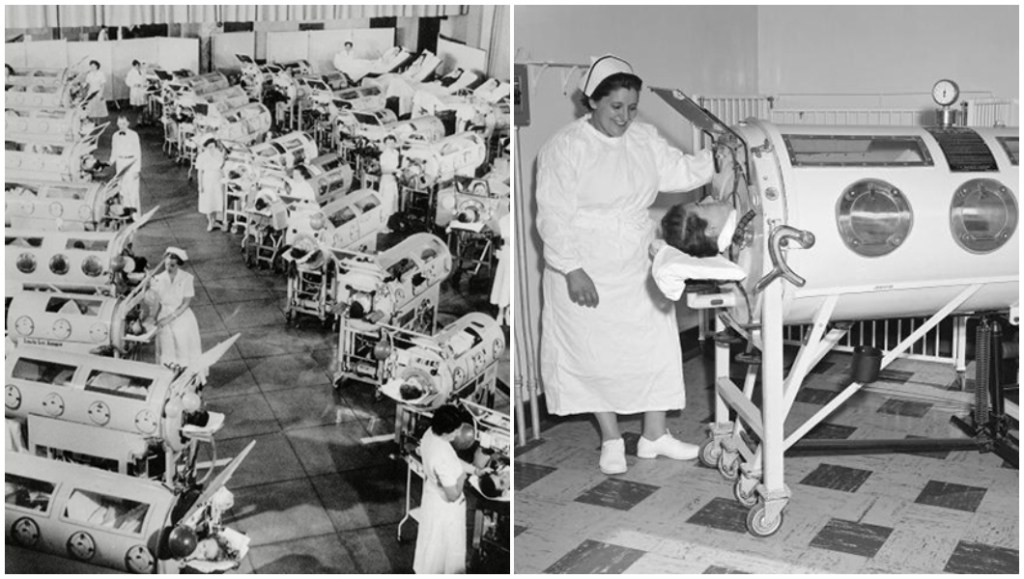
This was a metal cylinder that encased the whole body aside from the head. It created a vacuum that allowed the patient’s chest to expand and mimicked normal breathing. Once you had polio, there was no cure. Those who were not completely paralyzed often had to use crutches and heavy braces to support their legs. Some forms of physical therapy were developed that helped to some extent, but most people who had paralytic poliomyelitis were weakened and sometimes crippled for life.
Luckily, in the early 1950s, Jonas Salk, MD and his team developed a vaccine for polio using inactivated poliovirus. After large-scale trials, the vaccine was licensed and found to be 80-90% effective at preventing paralytic polio. Dr. Salk made no attempt to patent the vaccine, nor did he choose to profit from his breakthrough. A 2012 article in Forbes Magazine estimated that Dr. Salk could have made approximately $6 billion if he had patented his vaccine. The famous journalist Edward Morrow Interviewed him and asked, “Who owns this patent?” Salk replied, “Well, the people, I would say. There is no patent. Could you patent the sun?”
The vaccine was extraordinarily effective. When the vaccine was introduced in 1955, there were almost 30,000 cases of paralytic poliomyelitis. This fell to approximately 6000 cases in 1957 and in 1962, there were only 910 cases. Salk’s breakthrough was followed by the creation of an oral vaccine by Albert Sabin, MD. While this vaccine was not as effective as the Salk vaccine, it was less expensive, easier to administer and helped the population develop herd immunity. In the US between 2000 and 2025, there was only one reported case that developed in a nonvaccinated adult, so the disease has for all intents and purposes, been eradicated in our time.
I think that one of the problems driving current vaccine skepticism is a lack of historical perspective. Historical data shows just how bad infectious disease was in the not-so-distant past. With that in mind, I’ve designed a little thought experiment. What if vaccines and antibiotics had never been invented? What are the chances that you’d be reading this blog rather than being dead or never conceived? Let’s remember that for you to be here, every one of your parents, grandparents, and great-grandparents had to live long enough to produce offspring. It’s interesting to think about our existence from this perspective; the fact that any of us are here means that everyone in your direct line, including the microorganisms that eventually evolved into humans, survived long enough to reproduce. If even one of these organisms had died prematurely, you wouldn’t be here checking out your social media accounts. But let’s just consider people my age. I was born in 1955, and my parents were born in the 1930s. I know my grandfather on my father’s side was born in 1899, so all four of my grandparents must’ve been born around the turn of the century. Assuming my great-grandparents were in their early 20s when they gave birth to my grandparents, that takes us back to around 1875. Given the advances in vaccines and antibiotics over time, the odds of me being here were about 73%, and here I am.
But what if vaccines and antibiotics had never been invented, and infant mortality rates remained what they were in 1875? Let’s run the numbers:
| Generation | Number in Line | Survival Rate (%) | Probability All Survived (%) |
| Great-grandparents | 8 | 80 | 16% |
| Grandparents | 4 | 80 | 40% |
| Parents | 2 | 80 | 64% |
| All Generations | — | – – | 4% |
So this means that absent vaccines and antibiotics, there would be only a 4% chance that I’d be writing this blog and that you would be reading it.
My point in all this is that if you are a thinking person, you should be very skeptical of vaccine skepticism. Whether you lean left or lean right, I’d strongly suggest you do a little independent research on these subjects. Are mainstream scientific journals above reproach? Absolutely not; fraudulent research makes it through the review process from time to time, and it’s always possible to cook the books to make something without much consequence look like a big deal. Case in point is the idea that vaccines cause autism. I’ll go into this in more detail in a future post, but the whole ball got rolling when Andrew Wakefield published an article titled “Ileal-lymphoid-nodular hyperplasia, non-specific colitis, and pervasive developmental disorder in children” in, of all places, The Lancet, which has been one of the top British medical journals since 1823. Wakefield claimed to have found a link between the measles, mumps, and rubella vaccine and intestinal inflammation and autism in children. It attracted a great deal of attention and could be said to have been the origin of vaccine skepticism.
Unfortunately, the study was crap. How so, I hear you ask? Let me count the ways:
- Wakefield handpicked 12 children who already had symptoms that matched his predetermined conclusion rather than using a random sample
- He falsified records, altered timelines, and ignored the children’s preexisting conditions, including symptoms of autism
- Wakefield received 435,000 pounds from lawyers who were preparing lawsuits against vaccine manufacturers while patenting a rival vaccine and diagnostic kits for the the bogus syndrome he made up his own self
- All evidence that the vaccine-autism link discovered by Wakefield was omitted from the paper, while anecdotal accounts by parents were presented as supporting data
When all of this was discovered, the Lancet retracted the article and Wakefield was “struck off” the UK medical registry, which means he could no longer practice medicine. In 2018, he was awarded the “Rusty Razor” award “for pseudoscience and bad critical thinking” by The Skeptical Inquirer.
But some of my readers might ask, “What proof is there that Wakefield was wrong?” There’s plenty. There have been huge epidemiological studies that have compared the rates of autism in children who have been vaccinated with those who have not, and no link was observed. Also, the first symptoms of autism in children emerge just at the time when vaccines are routinely administered, which can make it look like the vaccines cause the autism. In reality, the autism emerges at that age whether the children are vaccinated or not. There is also debate about whether there really had been a significant increase in autism or whether the apparent increase in autism is an example of something called “criterion creep.”
Criterion creep is the gradual expansion of the boundaries of a diagnostic category so that more people are included under the diagnosis than before. This can happen when the criteria for a disorder are relaxed to include milder or less typical cases or when the definition is broadened to include new types of symptoms or situations. In psychology and psychiatry, this process can lead to overdiagnosis and the pathologizing of normal variations in behavior or experience. This is a big part of what happened with autism.
You might be aware that the Diagnostic and Statistical Manual of the American Psychiatric Association (better known as the DSM) is the ‘bible” of psychiatric diagnoses. It’s been around for a while and has gone through multiple revisions. The first time I ever saw the DSM, it was DSM-III back in the early 80s. We are now up to DSM-5. In DSM-III, you needed to meet 6 criteria to qualify for the diagnosis:
- Onset before 30 months
- Pervasive lack of responsiveness to other people (autism)
- Gross deficits in language development
- If speech is present, peculiar speech patterns such as immediate and delayed echolalia, metaphorical language, pronominal reversal
- Bizarre responses to various aspects of the environment, e.g., resistance to change, peculiar interest in or attachments to animate or inanimate objects
- Absence of delusions, hallucinations, loosening of associations, and incoherence as in schizophrenia.
In addition to these 6, they had to be severe and manifest before the child was 30 months old. At that point, it was estimated that 1 in 1400 children might be autistic.
Around 1987, the DSM-III was revised and called (unimaginatively enough) DSM-III-Revised (DSM-III-R). It relaxed the diagnostic criteria and allowed the diagnosis to be made on the basis of 8 out of 16 social, communication, or behavioral symptoms. The 30-month diagnosis window was 86ed as well. Also, another diagnosis was added; it was called pervasive developmental disorder not otherwise specified (PDD-NOS) and was a kind of catchall for children who seemed autistic but didn’t quite make the cut. You can probably see where this is going; you open up the criteria, and all of a sudden you have more folks with autism.
In 1994, DSM-IV appeared. Now we had 5 autism subtypes: autistic disorder, Asperger’s, childhood disintegrative disorder, Rett syndrome, and PDD-NOS. Asperger’s syndrome and PDD-NOS opened up the diagnosis to people without language delay or intellectual disability, and fewer core symptoms were needed than in DSM-III. Because of the broadened criteria, estimates of autism went from 1 in 1400 to 1 in 150, and we had an epidemic on our hands.
Then DSM-5 came along in 2013. All the new subtypes of autism were grouped together as autistic spectrum disorder and the criteria were again simplified and expanded. To qualify, the child or adult had to have deficits in social communication and 2 restricted behaviors, such as repetitive movements, behavioral rigidity, and sensory sensitivities to things like textures and sounds, and they didn’t have to be observed in childhood. Now it was estimated that 1 in 36 people had some kind of autism. In real numbers, that means that in 2000, there were about 1,800,000 people with autism in the US; now it’s closer to 9,000,000 people. This wasn’t just because of criterion creep; clinicians and school systems were now routinely screening children for autism and as the saying goes, you find what you look for.
To be clear, I’m not saying that the DSM-III was right and the DSM-5 criteria were wrong, but they really are fundamentally different diagnoses and if you compare the number of people diagnosed in the late 80s to the number diagnosed in 2025, you are comparing apples to oranges; the confusion comes in because these very different symptom pictures are all subsumed under a similar name.
This happens in many other diagnostic groups. Here is a simple example. Traditionally, people are diagnosed with intellectual disability (previously called mental retardation) if their IQ is around 70 or below. That means about 7.6 million Americans could be diagnosed with intellectual disability. When I was an intern in Cincinnati, Ohio, in the 1980s, there was an attempt to change the cut-off to an IQ score of 75. This would have changed the number of people with intellectual disability to 22,574,500. That’s quite an increase, but consider: the people with IQs of 75 were exactly the same as they were; we just changed the rules of the game. Another example: the medical criterion for people with dwarfism is 4’10”. Using this cutoff, there are about 30,000 to 60,000 people with dwarfism in the US. What if we changed the criterion?
- 5’—200,000-400,000
- 5’2″—79,000,000
- 5’3″—106,000,000
So just by adding 2 inches to the definition, we triple or quadruple the number of people with dwarfism. Again, everybody is the same height as they always were; only the definition has changed. So, if I want to create an epidemic of dwarfism in the US, all I have to do is convince the major medical organizations to move the goalposts.
So, is there an epidemic of autism? It’s not 100% clear, but probably not. And if there is no epidemic, then vaccines can’t cause an epidemic that isn’t happening. Also, in this blog, I’ve discussed the quality of research; there is a vast amount of top-quality research that should have put this nonsense to rest. So if that’s the case, why do RFK Jr. and his new CDC vaccine committee appointees either espouse the idea or flirt with it? Maybe they just don’t understand how science and research work, but that seems unlikely; after all, they have M.D.s or Ph.D.s. Believe me, having an advanced degree doesn’t mean you are a genius. But it strains credulity that this gang doesn’t know the difference between anecdote and speculative research, randomized studies, and meta-analysis. So if they aren’t a bunch of dummies, what’s their deal? A couple of possibilities come to mind. They might be a bunch of opportunists looking to make a quick buck from a credulous public. It’s also possible that they are paranoid conspiracy theorists; RFK Jr. seems pretty paranoid to me and maybe birds of a feather stick together, hence his selection process. And it could be some combination of both factors. But whatever the reason, I’d urge you to educate yourself about the actual science behind issues like vaccinations, detox diets, homeopathic remedies, and alternative medicine. Just because “a lot of people” are saying something doesn’t make it true.
Discover more from Samurai Shrink
Subscribe to get the latest posts sent to your email.
 Samurai Shrink
Hello from the UK
I am a thinking man and in 2020 when the lockdown started I thought ‘This is strange when people need to be out in the fresh air and sun after a dull wet winter.’ As time went on this became stranger especially when the NHS introduced masks in the blazing heat of June.
But by then I had worked out that they had rebranded the ‘flu which was why ‘flu cases almost disappeared to be replaced by COVID 19. It was a big clue. Rebranding is standard business practice when sales are falling as I am sure you know.
And then they were pushing the vaccine solution. Now I had realised back in the 1980’s that ‘flu vaccines made people ill so what was the point.
So I gave the COVID 19 vaccines a hard pass. In fact I give all vaccines a hard pass as I now realise that being poisoned by vaccines (they have to be poisons to create an immune response) is a bad idea.
As to alleged benefits, well, statistical correlation is not causation is it? And especially not when diseases get rebranded.
So I did educate myself about the actual science behind issues like vaccinations and found out they don’t work as we are told by the pharmaceutical industry and medical establishment.
So as to “Just because “a lot of people” are saying something doesn’t make it true” you are quite right, just because big pharma and medics etc. tell us vaccines are ‘safe and effective’ doesn’t make it true. Vaccines are pointless at best, harmful even deadly at worst. Sadly after 5 years of COVID nonsense many have yet to wake up. Perhaps they never will.
LikeLiked by 1 person