It was time to decamp from Tokyo. I couldn’t get a cab, so I took the subway to Tokyo station. It was a little daunting but not as bad as I thought it might be. I’m sitting in the station waiting to pick up the shinkansen for Kobe. Fun fact: this station serves 1.1 million people on average per day. Assuming that it’s equally distributed over 24 hours, that’s about 40,000 people at any given time, larger than Portsmouth, New Hampshire.
I made the train without difficulty; I have a reserved seat in first class. Before I boarded, I purchased a bento box, a small bottle of green tea, and a Sapporo for the 3-hour trip. Let me take this opportunity to wax lyrical about the bento box. They come in an endless array of sizes and prices and have all manner of content. I think the bento box tells you a great deal about the Japanese mind. Is it lunch? Is it art? Is it possible that the Japanese don’t necessarily see a distinction? I took some pictures to illustrate.

First of all, look at that little bundle of seaweed. It’s rolled up, and someone went to the trouble of tying it up with a minute filament of something edible.
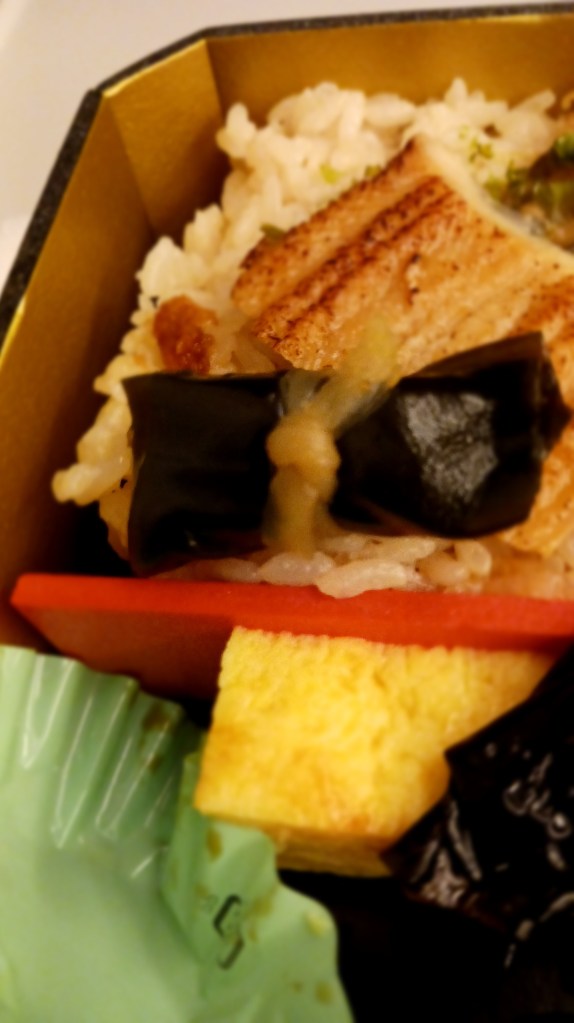
Who does that? And look at how the whole thing is arranged. In the upper right, there is a selection of seasonal vegetables, red pepper, pumpkin, and some kind of fish cake. There is also some simmered daikon radish, which appears a good deal in slow simmered oden. The Japanese cookbooks I’ve read discuss how it soaks up the flavors of whatever’s cooked in, but that hasn’t been my experience; it just tastes the way you’d expect a boiled radish to taste. There is always fishcake in one form or another; that crab you have in your California roll is fishcake, just emulsified pollock with flavoring. Sometimes it’s dyed different colors to make it decorative. Its kind of like the hamburger of Japan. The flavors are milder than we are used to, but in restaurants they often supply a red pepper shaker, and that stuff packs a wallop, yes indeed. The long thing is a shrimp breaded in panko, and the brown round thing is a small breaded pork cutlet, too sweet for my taste. But I love the presentation and the aesthetics.

See the little pile of stuff to the upper right of the piece of fish in the top left section? I had to squint to see, but it turns out they are tiny clams. Where they find such little clams, I can’t guess. Also, shucking clams that small would be one of the world’s worst jobs; you probably need a microscope and the world’s smallest oyster knife. “Hey, Kintaro, shake a leg! We just need to shuck 240,000 more of these, and we can go party with the gals who tie the little filament around the seaweed! Livin the dream, man!”
Another thing I love about Japan is the convenience stores. I’ve written about this before, but my admiration only grows. They have everything you could possibly need, unless you’ve been hit by a car and need medical attention. Every imaginable sandwich and desert, and some you’ve never imagined. Socks, USB cables, laundry soap, steamed buns, 100 kinds of ramen noodles, Suntory whisky, shoujo, and milk cartons of cheap sake (and I blush to say that the cheap stuff tastes a lot like the good stuff to me) and canned highballs. You can get 20 types of coffee from the machines and its Starbucks quality. I think that if you were on a budget and only ate at the konbini (their word for convenience store) and your friends asked how the food was in Japan, you’d say, “Pretty good and priced to move.”

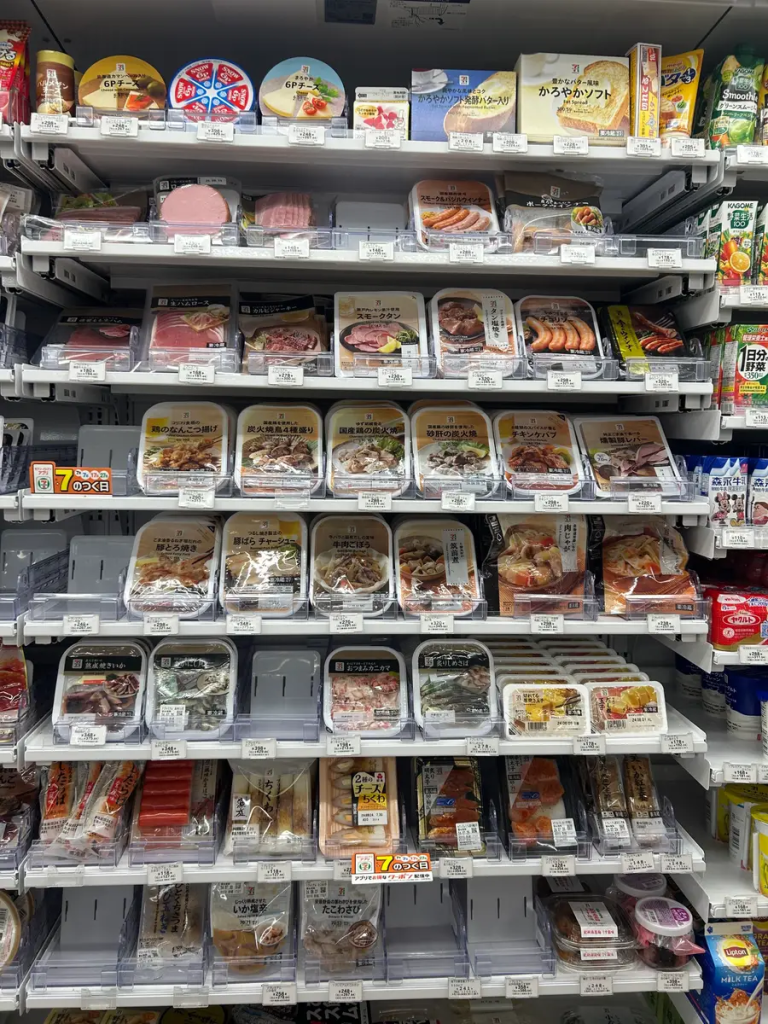
But I did some research, and there’s more to it than that. Japan has an aging population. 29% of its citizens are over 65, the second highest rate in the world. By comparison, the US has a rate of about 17%. The Konbini have responded by helping seniors “age in place.” They have started opening small seating areas for O-jiisan and O-basan (grandfather and grandmother, or any elderly man or woman) so they can hang out and chat. They have started delivering to shut-ins. Also, the Japanese hate the idea of wasting food, so many vendors of bento boxes and managers of konbini will distribute the food that will be out-dated to the homeless and poor on their way home from work. What a country!In any case, I finished my bento and Brewski and watched the countryside roll past; maybe “rolled” is the wrong word when you consider that the bullet train can reach 186 mph. Getting into Kobe was much easier than getting out of Tokyo. I grabbed a cab for a short ride to the hotel, settled in, and went exploring.
Not that I’m such a seasoned Asian traveler, but I do have a little advice if you are about to take a trip to Japan. Tokyo is an amazing place, but its daunting to get there and to get around the city. The mass of humanity can be difficult to deal with, and the whole place is challenging. I strongly recommend second- or even third-city destinations. Osaka Castle was astonishing, but the castle in Kanazawa was just as amazing. You want to eat ramen or soba, or drink at an Izakaya? Trust me, they have plenty in Kobe. You probably don’t want to get to far afield if you are new to Japan, but Osaka and Kyoto were great, and you didn’t have to be as worried about being trampled by a horde crossing the street.
More about Kobe in the next post.
Discover more from Samurai Shrink
Subscribe to get the latest posts sent to your email.
 Samurai Shrink