I’m 2 hours out of Boston and anxious to get home to the little woman, and when I say little, I ain’t joking around; I think my backpack weighs more. Its a long way back from Japan, particularly after you consider the layover. Its about 7000 miles, around a quarter of the way around the world. Right now the inflight map shows us heading for Montreal. This time we headed over the North Pole and down across Nunivaat. My experience reminded me of Lewis Black discussing his trip to New Zealand. He mentioned that the attendants try to distract you: liquor, food, movie, liquor, more food, and another movie, and you still have 10 hours to go.
Literary digression. I’ve read Homer’s Odyssey many times before I gave any thought to the logistics involved in his journey. I looked at a map, and it took him about 10 years to travel 500 miles. I could have circumnavigated the globe in my kayak about 3 times, with lengthy stops in Bangkok, Palermo, and Dublin to party. What do you think he said when he got home to Penelope? “Sorry, sweet thang, but traffic was terrible, and you know how the Massholians pilot their galleys; its a nightmare; what’s for dinner?”
We’re about 4 hours out of Hong Kong; the attendants dimmed the lights; I extended the bed in my cubby and tried to sleep. Like a recurring nightmare, Son of Snoring Guy was in the cubby behind me. This time I pulled up my playlist from my phone and fell asleep to Muddy Waters singing Rollin’ and Tumblin’ as my headphones cancelled out his snorts and whistles. I think I got about 4 hours of sleep. Not exactly refreshing, but better than 14 hours in economy with my knees up by my ears; I’m not sure I would have survived that, and I bet after the first 8, I would have welcomed death.
Customs was no big deal on this end. They ask you if you have any dangerous materials or weapons and you say no, and they apparently believe you. I made the 11:11 bus to Portsmouth and my car even started. I was welcomed home with cold beer and hot pizza, and it was good to see Kay. Thus ends the story of my adventure to the Land of the Rising Sun.
But what did I learn from all this? This was, after all, a kind of pilgrimage for me. I’ve always had romantic notions about Japan. I’m not sure when it started exactly. One contributing factor may have been my response to being bullied in 5th grade before I moved from South Euclid, Ohio, to Beachwood. I became tired of being pummeled on the playground by larger kids. I did some research (even then I was always reading; my parents bought me a set of encyclopedias and darn if I didn’t read the whole thing). In those days there was really only one martial art in the US, Judo, brought back to the States by members of the military who had been stationed in Japan. I took a few months of lessons and discovered I had some talent. Once I gained a little proficiency, I became more confident.
I vividly recall one of the larger 6th graders grabbing me by the front of my shirt and offering to punch my teeth down my throat. The thing is, having someone grab you like that is the perfect way to set yourself up to be thrown. It was simple to throw him, mostly because he didn’t know what was coming. These days, everyone watches MMA, and the days of winning a fight because you know some secret technique that nobody else knows are gone. But not then. I took my opponent over my hip with a technique known as O-goshi, one of the hip throws; 57 years later, I recall with pleasure the meaty sound of that putz hitting the blacktop. The other kids thought it was black magic and stopped bothering me.
But it wasn’t just judo. Something about the Japanese sense of design and aesthetics got to me early and stayed with me. I wrote haiku in high school [Note: I didn’t tell anyone at the time, in 1970. There was deep distrust for a young male who would voluntarily write a poem, and I was already suspect because of my shoulder bag and my early penchant for baking bread and cooking.] Then I went through my Zen Buddhism stage and actually went so far as to meditate. I didn’t keep it up. But to this day I can drop my heart rate and blood pressure by meditating.
Then there were the films: Kursawa films, The Seven Samurai, Yojimbo, Sanjuro, Red Beard, and Ran.
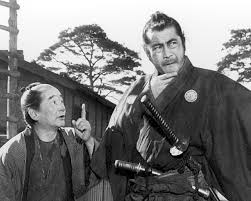

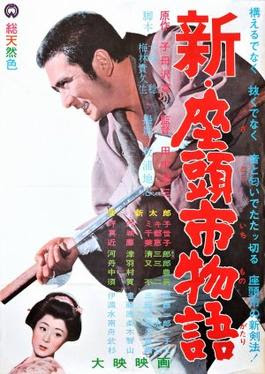
Then there were the Zatoichi films, about the wandering blind man and gambler who happens to be the world’s finest swordsman. He wanders the countryside, plying his trade and protecting the weak and downtrodden, leaving them with happiness he can never share.
There was the graphic design, Hiroshige, Hokusai, and Utagawa. I’ve always loved those prints and the office and the walls of the man cave are decorated with them. I didn’t know that the prints were mass produced and not considered anything special in Japan; they were discovered in America when they were found as packing material in shipments from Japan. But these days, it turns out that the Great Wave of Kanagawa is the most reproduced image in the world—in your face, Mona Lisa.

There was the graphic design, Hiroshige, Hokusai, and Utagawa. I’ve always loved those prints, and the office and the walls of the man cave are decorated with them. I didn’t know that the prints were mass-produced and not considered anything special in Japan; they were discovered in America when they were found as packing material in shipments from Japan. But these days, it turns out that the Great Wave of Kanagawa is the most reproduced image in the world—in your face, Mona Lisa.
Since it’s my blog and I can free-associate if I wanna, that reminds me about something I realized about tourism some years back. When it comes to visiting foreign lands, people (and I include myself) have a real herd mentality. We all go to see the Mona Lisa because we’ve been told that we should and that it’s the most important and maybe the best painting in the world. Have you ever looked at it? Either at the Louvre or online? If I didn’t know it was the Mona Lisa and I was walking around the Louvre, I’m not sure I would even notice it. When I was there a couple years ago, I must’ve seen 500 paintings that I liked more. You probably don’t have a copy of the Mona Lisa on your wall at home, do you? Why not, if it’s so good? The answer is simple; it’s because it isn’t that great; we’ve just been told that it is.
This idea really hit me when I was at Westminster Abbey in the poet’s corner, where you can see the graves of famous English poets. There I was, standing over the grave of Ben Johnson, an influential writer and poet of the 15th century. My first thought was, “Wow, this is the grave of Ben Johnson.” My second thought was, “So what? I’m standing over a piece of rock that has the words ‘Ben Johnson’ chiseled on it. It’s not like I get to meet him or see him or anything; I just get to see this rock. This is a complete waste of time, isn’t it?”

That’s why I wasn’t big on hitting up all the attractions and shrines that the guidebook said I have to see in Japan; I just wanted to hang out and buy an egg salad sandwich from the local Lawson’s, eat some conveyor belt sushi, drink some Sapporo, and maybe meet a few people. I got my wish, and then some.
Did I learn anything from my trip? They say travel broadens the mind and I think mine might be a little broader than when I left. I learned a few things that may seem pretty obvious, but in my experience, some of the most profound personal revelations seem obvious on the surface. Back when I was in graduate school, I was in psychoanalysis, on the couch three days a week for almost 3 years. My big revelations were that sometimes my family was not as happy as I thought it was and that I wasn’t always such a nice guy. Those seem like pretty limited personal insights for three years of intensive psychotherapy but they had a major impact on the way I lived my life thereafter.
I learned a couple things that may seem pretty obvious. Our experience living in the United States is very different from what most people in the rest of the world experience. If you live in the EU, you come in contact with many other countries and many other languages, while we Americans pretty much speak the same language and tend to think of ourselves as the center of the universe. But the reality is that most people in the world live in the East. Wikipedia tells me that China has about a billion and a half people, with India set to overtake China in a few years. The US has about 335,000,000, or about one tenth of their population. Japan alone has 125 million people. We think of ourselves as the protagonists of the global story but I’m reminded of something that one of my coaches once said to me. He told me that when I was worried about something, I should just remind myself that there were a billion people in China who couldn’t possibly care less. Traveling to the east opened my eyes to the fact that we are far from the center of things here in the United States.
Another thing I learned is that there are entire cultures that have very different worldviews than we do. Japan was by far the most foreign place I’ve ever been. A big part of that comes from their never having been part of the whole Judeo-Christian thing. The Japanese as a group are very cooperative and polite and live very different lives than we do, with very different values. My late friend Sam Asaro told me that the Japanese have a very different view of death. He told me that they don’t make such a big deal out of mortality, since they just see death as a transition to another phase. Once you get past the language barrier, you can talk to the Japanese, and they don’t seem so different from you, but many of their basic assumptions about who people are in relation to each other and their place in society are very different indeed. Is it better? My take based on everything I’ve read and my two weeks there (which is clearly a very limited data set) is that, like most things, it depends. We have more individual freedom and in fact, by most measures, we are the most individualistic culture in the world. We have more choices about where to live and just because someone with a little more status tells us to jump, we don’t necessarily ask, “How high?” On the other hand, we yell at each other in restaurants and there’s a lot more litter on the streets. Like most things in life, you pay your money and you take your chances.
For me personally, now that the jetlag has now that the jetlag has subsided I realize I really needed to do this. I was in a real rut and I was starting to feel old. Walking around the streets of Osaka and Kyoto, I felt emotions that I have not experienced for a very long time. I think that on some level I felt like I would just keep doing what I’ve been doing and run out the clock. I feel like the experience of all that foreignness blew out the neural circuitry. Now I feel more optimistic and energetic and there are things I want to do: some more articles, maybe a book or two and a lot more travel. I’ve been learning the blues harp and maybe I’ll get a few guys from the ukulele group that I go to every Wednesday and see about starting a blues band. Maybe I’ll start making tea bowls again. I may even clean up the man cave a little bit. My advice is that if you have the money and get the opportunity, go visit Japan. Walk through the markets, eat some conveyor belt sushi, and visit a shrine or two. You won’t be sorry.
Erikku Matto11/23/2024

Discover more from Samurai Shrink
Subscribe to get the latest posts sent to your email.
 Samurai Shrink